
Large Language Models power the most impressive AI applications today, from chatbots to coding assistants to translation tools. This guide explains how they work under the hood. HuaHai brings LLM capabilities to wearable AI devices with on-device inference.
What Is an LLM?
A Large Language Model is a neural network trained on massive amounts of text data to understand and generate human language. The Wikipedia article on LLMs explains the fundamentals. LLMs predict the next word in a sequence based on the words that came before — but through training on billions of examples, they develop remarkable capabilities including reasoning, translation, summarization, and code generation.
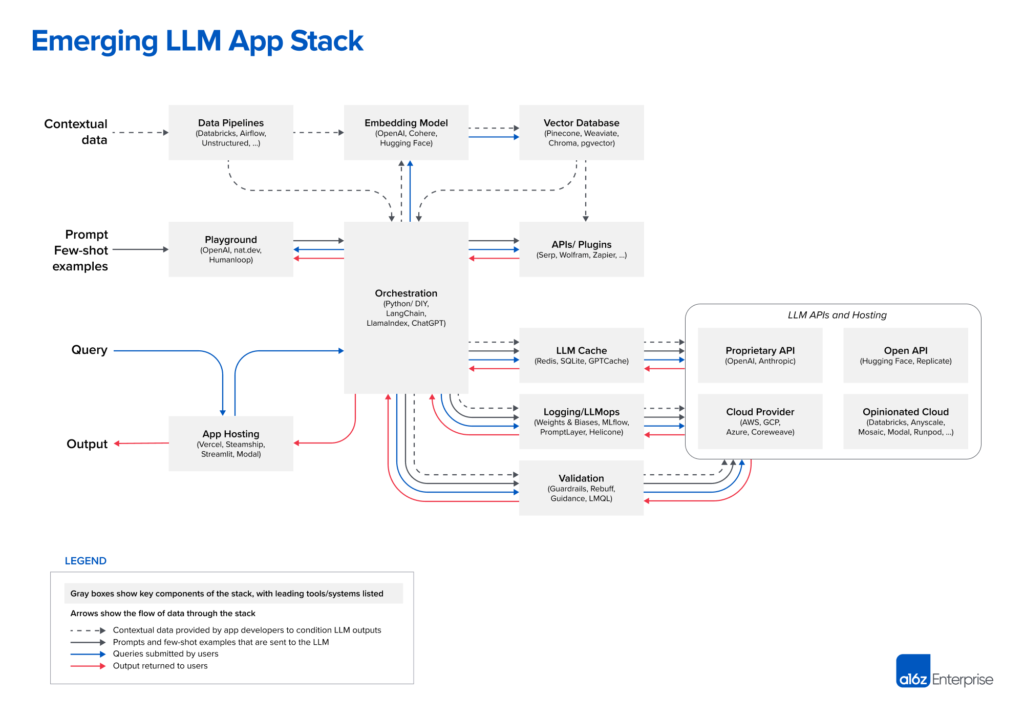
Transformer Architecture
The Transformer architecture, introduced in the 2017 paper “Attention Is All You Need,” revolutionized NLP: Unlike previous recurrent models that processed words sequentially, Transformers process all words in parallel using a mechanism called “self-attention.” Self-attention weighs the importance of each word relative to every other word in the input. This parallel processing enables training on much larger datasets and capturing long-range dependencies. The architecture consists of an encoder (for understanding) and a decoder (for generation), though many modern LLMs use decoder-only architectures.
How LLMs Are Trained
LLM training happens in three main phases. Pre-training: The model learns from vast unlabeled text data (trillions of words from the internet, books, articles) by predicting missing words. Fine-tuning: The pre-trained model is refined on labeled data for specific tasks. RLHF (Reinforcement Learning from Human Feedback): Human feedback teaches the model to produce preferred responses. This three-stage process creates models that are knowledgeable, task-capable, and aligned with human preferences.
Tokens and Tokenization
LLMs process text as tokens — chunks of characters that represent words or subwords. “Hello world” might be tokenized as [“Hello”, ” world”] or [“Hel”, “lo”, ” world”]. Different tokenizers produce different token counts. A typical English word is about 1.3 tokens. Token limits determine how much text a model can process in a single request. The arXiv machine learning papers frequently discuss tokenization advances.
Context Windows
| Model | Context Window | Approx. Pages |
|---|---|---|
| GPT-4o | 128K tokens | ~200 pages |
| Claude 3.5/4 | 200K tokens | ~300 pages |
| Gemini 2.0 Pro | 1M tokens | ~1,500 pages |
| DeepSeek-V3 | 128K tokens | ~200 pages |
Parameters and Scale
Model parameters are the weights that define the model’s knowledge. GPT-3 (175B parameters) showed that scale leads to emergent capabilities. GPT-4 is estimated at 1.7 trillion parameters (mixture of experts). Claude 3.5 Opus and Gemini Ultra are similarly large. Larger models cost more to train and run but generally perform better. Small models (7B-70B parameters) can run on edge devices like AI glasses after optimization.
GPT-4o vs Claude vs Gemini vs DeepSeek
GPT-4o: OpenAI’s flagship, best for general tasks, multimodal, strong coding, $20/month. Claude 3.5/4: Anthropic’s model, exceptional at writing and analysis, 200K context, strong safety focus. Gemini 2.0 Pro: Google’s model, 1M context window, deep Google Workspace integration. DeepSeek-V3: Chinese open-source model, competitive performance at lower cost. Each has strengths — the best choice depends on your specific use case.
Training Costs
Training a state-of-the-art LLM costs $50-200 million in compute alone. GPT-4’s training cost is estimated at $100-150 million. Inference costs run $0.01-0.10 per 1K tokens depending on the model. Smaller models optimized for edge devices can run locally with minimal ongoing costs.
LLMs on Edge Devices
Running LLMs on edge devices like phones, smart glasses, and IoT hardware requires optimization. Techniques include quantization (reducing precision from 32-bit to 4-bit), pruning (removing unnecessary connections), and distillation (training a smaller model to mimic a larger one). The latest generation of AI glasses can run 7B-13B parameter LLMs locally for tasks like real-time translation and contextual assistance.
FAQ
How do LLMs understand language?
LLMs do not “understand” like humans. They learn statistical patterns from massive text data and predict probable word sequences. The result often appears as understanding.
What does “parameters” mean in LLMs?
Parameters are the numerical weights learned during training. More parameters generally mean more capacity to learn complex patterns but require more compute.
What is the difference between GPT, Claude, and Gemini?
They are competing LLMs from OpenAI, Anthropic, and Google. They differ in architecture, training data, context window size, pricing, and performance on specific tasks.
Can LLMs run on devices like smart glasses?
Yes. Optimized small LLMs (7B-13B parameters) can run on edge hardware in wearable devices for on-device AI capabilities.
LLM-Powered Wearables from HuaHai
HuaHai smart glasses run optimized LLMs for real-time on-device assistance. Explore our AI glasses or contact us for custom AI wearable development.