
Short answer
Yes, you can use ChatGPT on smart glasses, but in most cases the glasses are only the microphone and speaker. The ChatGPT model runs in the cloud, reached through a phone app or the maker’s own app. Some products advertise ChatGPT as a built-in assistant. Others rely on a phone workaround, and some use a different assistant altogether, so check the activation path and the model before you buy or source.
Key Takeaways
- There are three common routes: a phone-based audio link, an assistant built into the maker’s companion app, and an assistant that runs partly on the glasses themselves.
- A cloud model needs a connection. If the phone or app is offline, the assistant stops, even if music and calls still work.
- “ChatGPT built in” is a marketing phrase. Ask which model, which app, how the assistant is activated and where it is available.
- Camera, privacy and subscription terms depend on the maker, not on ChatGPT itself.
- Brands and distributors should verify the integration with the supplier in writing and avoid wording that suggests a partnership with the AI provider.
Can you use ChatGPT on smart glasses?
You can use ChatGPT on smart glasses in three ways, and each gives a different experience. The table compares them.
| Route | How it works | Typical strength | Typical limit |
|---|---|---|---|
| Phone-based audio link | You open an AI app on your phone and use the glasses as a Bluetooth microphone and speaker | Works with many Bluetooth audio glasses | Needs the phone in hand to start, and the glasses add nothing beyond audio |
| Companion-app assistant | The maker’s app connects to a cloud model; a wake word or touch gesture on the glasses starts it | Hands-free use, tuned for the glasses’ features | Depends on the app staying active on the phone and on the maker’s service |
| Assistant on the glasses | The glasses run an operating system or chip that handles some AI tasks locally and sends harder ones to the cloud | Faster for simple tasks; can work with sensors such as the camera | More hardware cost, weight and power use |
A single product can combine routes. For example, a model may run wake-word detection on the glasses, speech recognition in the app and the language model in the cloud.
How does an AI assistant connect to smart glasses?
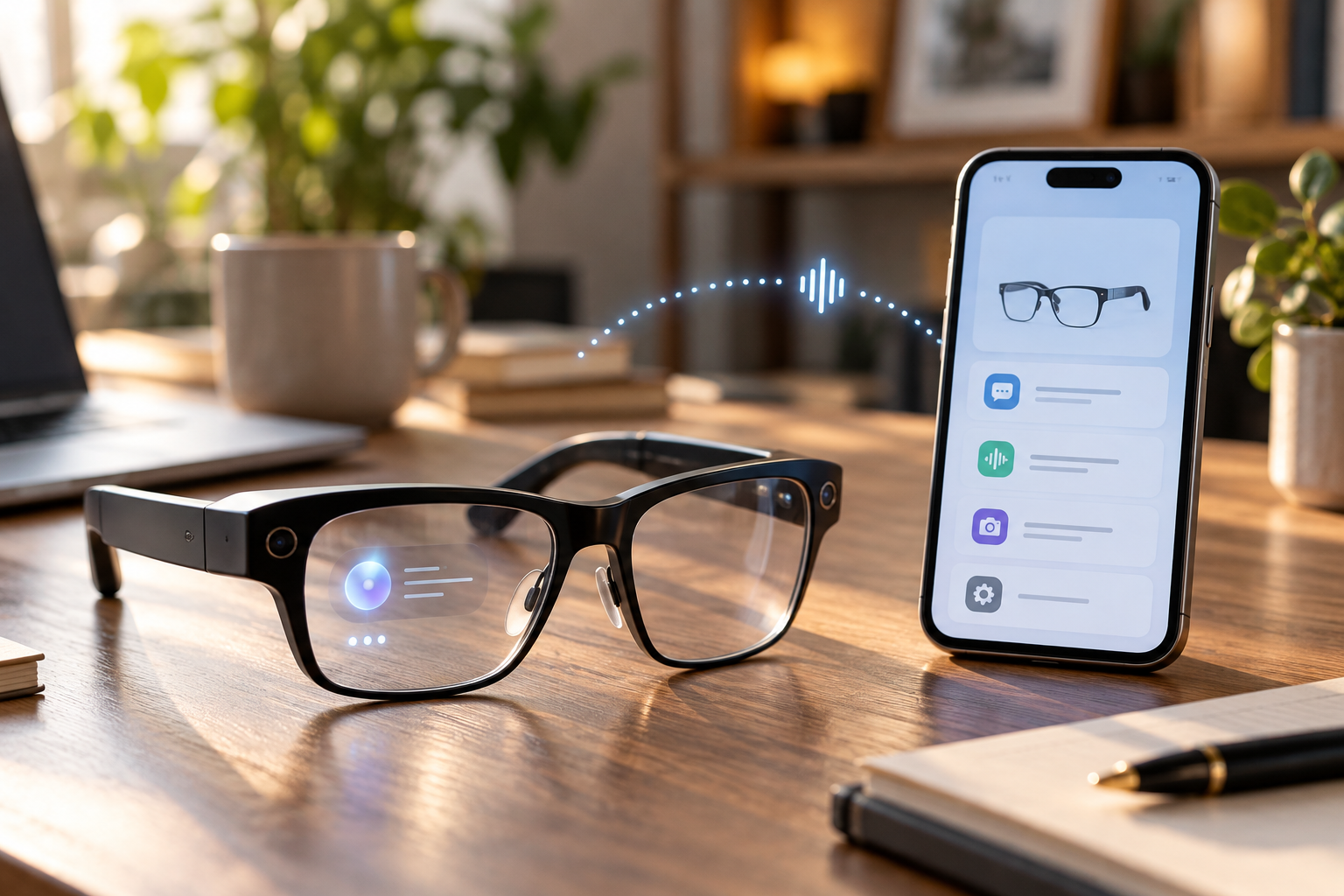
An AI assistant connects to smart glasses through a chain: the glasses capture your voice, a phone or app sends it to a cloud model, and the answer comes back as audio or on a display. The glasses talk to the phone over Bluetooth or Wi-Fi, and the phone provides the internet link.
- Capture: the microphones pick up your request after a wake word or a touch gesture.
- Transfer: the audio goes to the phone or app, which adds the internet connection.
- Processing: a cloud model turns the request into an answer. The steps may be separate (speech to text, language model, text to speech) or combined in one speech model.
- Delivery: the reply plays through the open-ear speakers, or appears in the app or on a display.
OpenAI’s developer guide, “Audio and voice”, describes the two ways developers build voice features: a speech-to-speech agent, or a chain of speech-to-text, a text agent and then text-to-speech (OpenAI: Audio and voice, checked October 2026; the page shows no date). A glasses maker picks one of these designs, and the choice affects delay and cost.
Not every feature goes to the cloud. Meta says its live translation feature on Ray-Ban Meta glasses is processed on the glasses and can work without internet access (Meta, November 14, 2025). That is a different design from a chatbot that needs a live connection. Our article on how AI smart glasses work explains the basic hardware, and the one on translation accuracy covers delay and offline use.
What does “ChatGPT built in” mean on a spec sheet?
“ChatGPT built in” on a spec sheet means the product connects to a ChatGPT-class model through its app, not that the model runs on the glasses. The phrase tells you little about quality or about how easy the assistant is to start. Ask these questions to find out what a supplier means:
- Activation path: can you start the assistant with a wake word or a touch gesture on the frame, or do you have to open an app first?
- Model and service: which model and which provider are used, and does that change by region?
- App dependence: does the assistant need the companion app to stay open in the background on the phone?
- Features: does it answer questions only, or can it also take photos, translate and control the glasses?
- Cost: are there usage limits or paid tiers? See our article on smart glasses subscriptions.

What do you need to use ChatGPT on smart glasses?
You need a paired phone, the glasses’ companion app, an internet connection and, for some routes, an account with the AI provider. The exact list depends on the route, so read the product’s setup guide before you promise a feature to customers.
- Phone: a supported iOS or Android phone with Bluetooth on and the right permissions for microphone and location.
- Companion app: installed, paired with the glasses and kept up to date.
- Connection: mobile data or Wi-Fi on the phone, because the glasses usually reach the internet through it.
- Account: an account with the maker or the AI provider, if the route requires one.
- Region and language: the assistant and its language support must be available in your country.
How is ChatGPT different from Meta AI and other glasses assistants?
ChatGPT is a general chatbot from OpenAI, while Meta AI is the assistant Meta builds into its own glasses, and other makers use their own assistants or connect to different models. Meta’s help page says you activate Meta AI on Ray-Ban Meta or Oakley Meta glasses by saying “Hey Meta” or by tapping and holding the touchpad, and that Meta AI can answer questions about what the camera sees (Meta Help: How to use Meta AI on AI glasses, checked October 2026; the page shows no calendar date). The page does not mention ChatGPT.
The practical difference for a buyer is integration, not intelligence:
- Built-in assistant: usually has the best access to the glasses’ functions, such as the camera and settings.
- Third-party assistant through a phone: may offer broader chat ability but less control over the glasses.
- Model choice: some products let the user pick a model, others fix it in the app.
We make no comparison of answer quality between assistants here, because it changes with every model update. Test the assistant you plan to offer, with your customers’ questions and languages.
What are the limits and privacy issues of ChatGPT on glasses?
The main limits are dependence on a connection, response delay, and what the assistant can access on the glasses. A phone-based session can only use what the phone app receives, which is usually audio and not the glasses’ camera or settings, unless the maker has built that link.
- Connection: a weak signal, airplane mode or an app that the phone puts to sleep can stop the assistant.
- Delay: every step in the chain adds time, so answers arrive later than on-device commands such as taking a photo.
- Activation: not every route has a hands-free wake word for the chosen assistant.
- Cost: cloud use can come with limits or paid tiers, and terms can change after purchase.
- Language and region: support varies by market and by model.
Privacy needs attention because the audio, and sometimes images, leave the glasses. The European Data Protection Board’s October 2026 statement on smart glasses says manufacturers and linked app or AI service providers remain subject to the GDPR and may be controllers. Our guide to the legal limits of recording eyewear covers where recording rules apply. This is general information, not legal advice.
What should brands and distributors check before selling “ChatGPT” glasses?
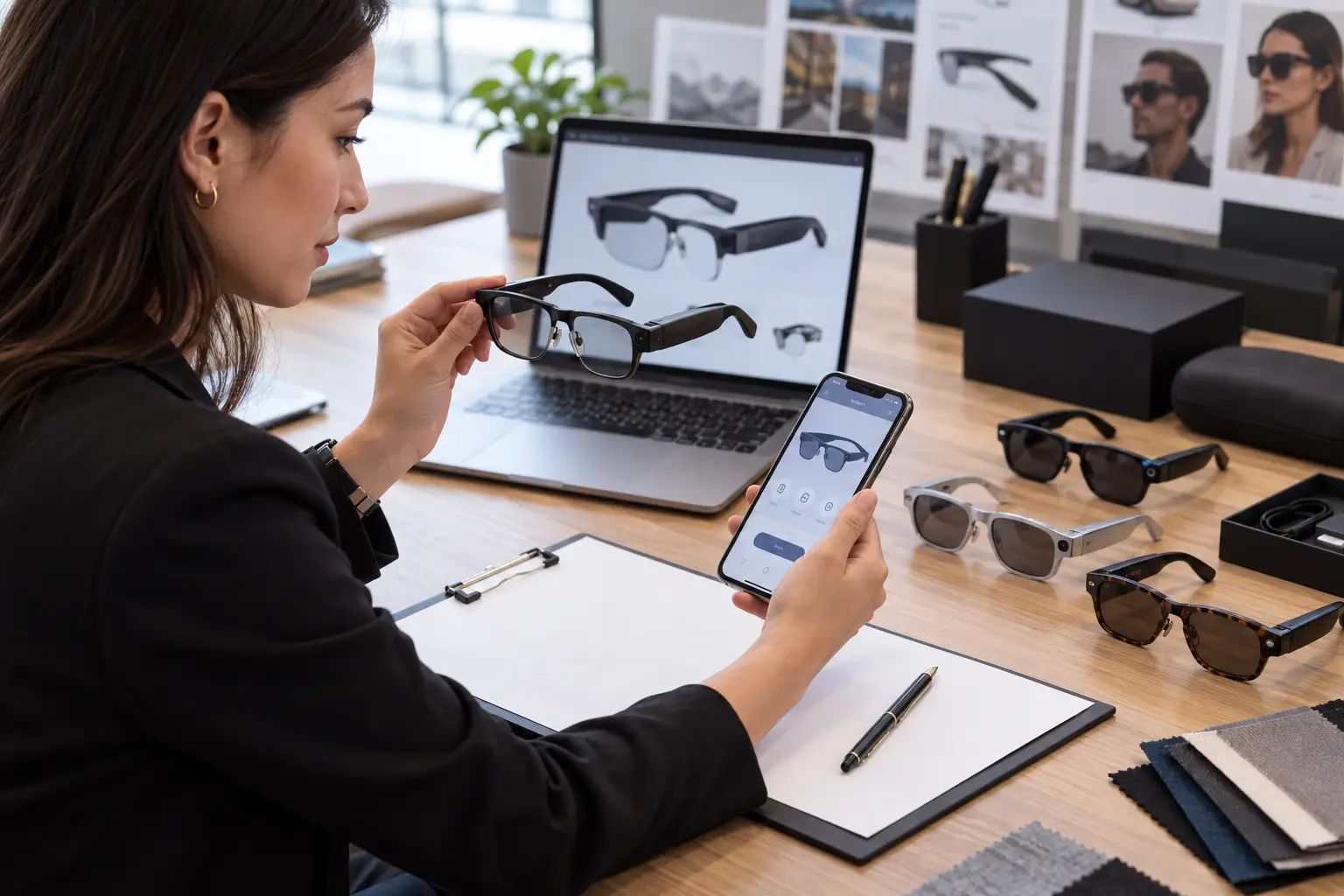
Brands and distributors should verify the integration, the activation path and the service terms in writing, and word their marketing to match. Complaints about AI glasses often start when a headline claim promises more than the real setup delivers. The table pairs common claims with what to confirm.
| Claim in marketing | What to confirm with the supplier |
|---|---|
| “ChatGPT built in” | Which model and provider, how it is reached, and who holds the account with that provider |
| “Hands-free AI” | Wake word or gesture on the frame, languages supported, and whether the app must stay open |
| “Works anywhere” | Connection needs, offline behavior and regions where the assistant is available |
| “Free AI” | Usage limits, paid tiers and who can change them after sale |
| “Private” | Where voice and image data go, how long they are kept and who the data controller is |
| “Camera AI” | Whether the assistant can use the camera, and how recording is signaled to bystanders |
Two further points protect your brand:
- Naming: do not use another company’s name or logo in a way that suggests a partnership. Check the AI provider’s current brand and usage terms before you print a name on a box.
- Continuity: ask what happens to your units if the provider changes its price, retires a model or restricts a region.
Our 12-point supplier checklist covers the wider review for any smart glasses order.
How does HuaHai approach this?
HuaHai lists AI assistant features on several models, and the details differ by product. This article does not claim any partnership with OpenAI. Specifications below are as listed on the product pages.
- V03: HuaHai lists the “Hey Cyan” wake word, ChatGPT and translation through the Hey Cyan App, and says V03 uses ChatGPT as its AI model outside China. See the V03 product page.
- X01: HuaHai lists voice assistant, translation and ChatGPT integration, with dual-microphone noise reduction and customizable lenses, frame colors and branding. See the X01 product page.
- HY16: HuaHai lists an AI assistant, translation and AI meeting notes through its companion app. See the HY16 product page.
- V06: HuaHai lists a voice assistant with the “Hello Echo” wake word on this sports model.
For a brand project, ask HuaHai which AI service each model uses in your target market, how the app is branded and updated, and what usage terms apply. The stock V03, V06 and HY16 pages list a minimum order of one pair and say samples ship within 48 hours, so you can test the activation path yourself. See the camera smart glasses category for the full range.
Sourcing smart glasses for your brand?
Frequently Asked Questions
Can you use ChatGPT on smart glasses?
You can use ChatGPT on smart glasses through a phone audio link, through a maker’s companion app, or through an assistant that runs partly on the glasses. In most cases the model runs in the cloud, so you need a phone and an internet connection. Check each product’s activation path.
Does ChatGPT run on the glasses themselves?
ChatGPT does not usually run on the glasses themselves. The glasses capture your voice and play the answer, while a cloud model does the work through a phone or app. Some simple tasks, such as wake-word detection, can run on the glasses.
Do smart glasses with ChatGPT work without internet?
Smart glasses with ChatGPT generally need an internet connection for chatbot answers, because the model is in the cloud. Local functions such as music and calls may still work offline. Ask the supplier which features work without a connection.
Is ChatGPT on smart glasses free?
ChatGPT on smart glasses may be free, limited or paid, depending on the maker’s terms. Cloud AI services bill the maker for use, so some brands set limits or add subscriptions. Confirm the free features and any usage limits before you buy or advertise them.
Can smart glasses use ChatGPT with the camera?
Smart glasses can use ChatGPT with the camera only if the maker has built that link between the camera and the assistant. A plain phone audio link usually carries voice only. Ask the supplier whether the assistant can see images and how that data is handled.
Bottom line
You can use ChatGPT on smart glasses, but the experience depends on the route: a phone audio link, a companion-app assistant, or an assistant that runs partly on the glasses. Buyers should look at the activation path, the connection needs and the cost terms, not at the phrase “built in”. Brands and distributors should confirm the model, the service and the data handling with the supplier in writing, and keep marketing claims within what they can show.