
Battery life is one of the most important factors when choosing AI glasses. A pair of AI glasses may look stylish and support many smart features, but if the battery drains too fast, the user experience will suffer.
For brands, distributors, and OEM/ODM buyers, battery life is not just a number on a specification sheet. It affects product positioning, customer reviews, return rates, and long-term brand trust.
This guide explains what affects AI glasses battery life, how to read battery specifications, and what buyers should check before choosing or customizing AI glasses.
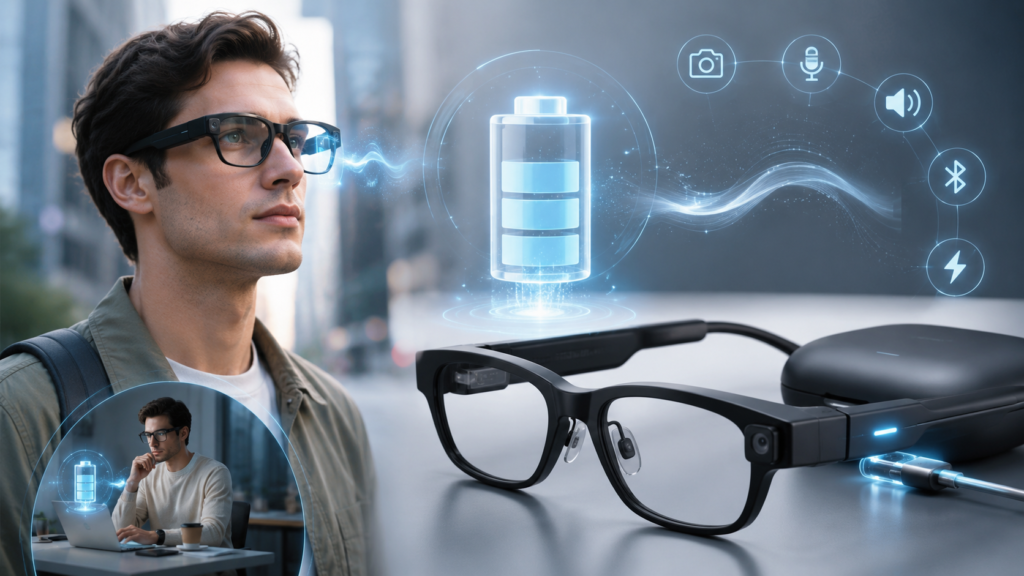
Quick Answer: What Affects AI Glasses Battery Life?
| Factor | Why It Matters |
|---|---|
| Battery Capacity | Larger batteries usually support longer use, but may increase weight |
| Function Type | Audio, translation, camera, and AI assistant consume power differently |
| Bluetooth Chip | Efficient chips can improve battery performance |
| Microphone Use | Real-time voice pickup uses extra power |
| Speaker Output | Higher volume drains the battery faster |
| Camera Use | Photo, video, and live streaming use much more power |
| App Connection | Constant app communication can shorten battery life |
| Lens / Display Function | Display-based functions consume more power |
| Weight Balance | Bigger battery may affect comfort |
| Charging Design | Fast and stable charging improves daily use |
What Does Battery Life Mean for AI Glasses?
AI glasses battery life means how long the glasses can work after one full charge. But this number can change a lot depending on how the user uses the product.
For example, music playback may last longer than real-time translation. Standby time may look very long, but it does not mean the glasses can actively work for that many hours. Video recording usually drains the battery faster than calling or listening to audio.
That is why buyers should not only ask, “How many hours does it last?” A better question is, “How long does it last under my target use case?”
Common Battery Life Terms Buyers Should Understand
1. Standby Time
Standby time means how long the glasses can stay powered on without heavy use. This number is often much higher than real working time.
Standby time is useful, but it should not be the main selling point if your customers will use translation, calling, music, or camera functions often.
2. Music Playback Time
Music playback time shows how long the glasses can play audio continuously. This is important for Bluetooth audio glasses and open-ear smart glasses.
However, playback time can change based on volume level, Bluetooth distance, chip efficiency, and speaker design.
3. Calling Time
Calling time is usually shorter than music playback time because microphones and audio transmission work at the same time.
If your target users need AI glasses for business calls, meetings, or driving communication, calling time should be checked carefully.
4. Translation Time
AI translation glasses need microphone pickup, Bluetooth or app connection, speech processing, and audio output. This means translation can use more power than simple music playback.
For travel or business users, stable translation time is more important than a very long standby number.
5. Recording Time
Camera AI glasses use more battery because video capture, image processing, storage, and heat control all consume power.
If your product includes camera or live streaming functions, do not judge battery life based only on audio mode.
Why AI Glasses Battery Life Is Different From Normal Earbuds
Many buyers compare AI glasses with wireless earbuds, but the structure is different.
Earbuds sit inside a compact charging case and are designed mainly for audio. AI glasses need to balance electronics, lens structure, temples, frame comfort, weight, and appearance. The battery is usually placed inside the glasses temples, so space is limited.
This makes battery design harder. A larger battery can improve working time, but it may also make the temples heavier or thicker. If the glasses become uncomfortable, customers may stop wearing them even if the battery is strong.
Good AI glasses need balance: enough battery life, comfortable weight, stable performance, and a natural wearing experience.
Main Factors That Affect AI Glasses Battery Life
1. Battery Capacity
Battery capacity is usually measured in mAh. A higher capacity can support longer use, but it is not the only factor.
Two AI glasses with similar battery capacity may perform differently because of chip design, speaker power, software optimization, and function type.
For OEM and ODM buyers, battery capacity should be discussed together with product weight and temple size.
2. Chip and Power Management
The Bluetooth chip or main control chip plays a major role in power consumption. A more efficient chip can help extend battery life without increasing battery size.
Power management also matters. Good firmware can reduce unnecessary power use when the glasses are idle, disconnected, or running light tasks.
3. Speaker and Volume Level
AI glasses often use open-ear speakers or bone-conduction modules. Higher volume needs more power.
In real use, users may turn up the volume in outdoor or noisy environments. This can reduce actual battery life compared with lab test results.
If the product is designed for outdoor use, buyers should test audio performance in real-world noise, not only in a quiet room.
4. Microphone and Voice Pickup
Microphones are important for calls, voice assistant, translation, and meeting recording. Some AI glasses use multiple microphones for noise reduction.
Better voice pickup improves user experience, but it may also increase power consumption. Translation glasses and business meeting glasses should balance microphone quality and battery life carefully.
5. Camera and Video Recording
Camera models usually consume more power than audio-only models. Video recording uses the camera sensor, processor, storage, wireless transfer, and sometimes app connection.
This also creates heat. If the frame is too small or heat control is weak, the user experience may suffer during long recording sessions.
For camera AI glasses, buyers should check both recording time and heat performance.
6. App Connection and AI Processing
Many AI functions rely on a mobile app or cloud service. When the glasses keep sending data to the phone or app, battery life may drop.
Translation, voice assistant, meeting transcription, and smart notification functions may all depend on software communication.
Buyers should test whether the glasses stay connected smoothly and whether battery life changes during long app-based use.
7. Charging Case or Charging Cable
Some AI glasses use a magnetic charging cable. Some use a charging case. A charging case can improve total daily use time, but it may increase product cost and packaging size.
For travel and outdoor users, a charging case can be a strong selling point. For office users, a simple magnetic cable may be enough.
AI Glasses Battery Life by Product Type
| Product Type | Battery Focus | Buyer Notes |
|---|---|---|
| Bluetooth Audio Glasses | Music and call time | Check volume, sound leakage, and comfort |
| AI Translation Glasses | Translation and microphone use time | Test real-time translation under real use |
| Camera AI Glasses | Recording time and heat control | Check video time, storage, and privacy design |
| Sports Smart Glasses | Outdoor use and sweat resistance | Check fit, battery, and charging stability |
| Bone-Conduction Glasses | Audio power and vibration module | Check sound clarity and battery balance |
| Photochromic AI Glasses | Daily use flexibility | Battery focus depends on smart functions |
What Battery Life Is Good for AI Glasses?
There is no single perfect number for all AI glasses. Good battery life depends on product type and customer expectations.
For Bluetooth audio glasses, users usually expect several hours of music or calls. For AI translation glasses, users care more about stable translation during travel, meetings, or daily communication. For camera glasses, even shorter active recording time may be acceptable if the product is positioned for short clips or quick capture.
Instead of chasing the longest battery life, buyers should define the main use case first.
A good battery plan should answer:
- How long will users wear the glasses each day?
- Which function will they use most?
- Will they use the product indoors or outdoors?
- Do they need all-day standby?
- Is charging during the day acceptable?
- Is a charging case needed?
- How much weight can users accept?
How Buyers Should Read Battery Specifications
Battery specifications can be confusing. Some suppliers may highlight standby time because it looks impressive. But standby time is not the same as active use time.
Buyers should ask for separate battery data, such as:
| Battery Item | Why It Matters |
|---|---|
| Standby Time | Shows basic power retention |
| Music Playback Time | Useful for audio glasses |
| Calling Time | Important for business and driving use |
| Translation Time | Important for AI translation glasses |
| Recording Time | Important for camera glasses |
| Charging Time | Affects daily convenience |
| Battery Capacity | Helps compare hardware design |
| Charging Method | Affects user experience |
| Charging Case Capacity | Important for travel products |
The best way is to test samples under real use. Lab data is useful, but real customers use different volume levels, apps, environments, and habits.
Battery Life and Product Design Balance
Battery life is not only an electronic issue. It is also a design issue.
If the battery is too small, the product may not last long enough. If the battery is too large, the glasses may become heavy, thick, or uncomfortable. If the temples are poorly balanced, users may feel pressure after wearing them for a short time.
This is why AI glasses development needs both electronics knowledge and eyewear design experience.
For OEM/ODM projects, buyers should not push for the largest battery without checking comfort. A balanced design often sells better than a heavy product with a longer battery number.
Battery Life Considerations for OEM and ODM Customization
When customizing AI glasses, buyers should discuss battery life early in the project.
Important questions include:
- Can the battery capacity be changed?
- Will a larger battery change the frame size?
- Will weight increase?
- Can the charging method be customized?
- Is a charging case available?
- Can the firmware be optimized for power saving?
- How does battery life change with translation, calls, music, or camera use?
- What battery testing does the factory perform?
For private label projects, battery customization may be limited because the model already has a fixed structure. For OEM projects, there may be more room to adjust the battery, frame, chip, and charging solution.
Common Battery Life Mistakes Buyers Should Avoid
Mistake 1: Only Looking at Standby Time
Standby time can look impressive, but customers care about real use time. Always check active use time for your main function.
Mistake 2: Adding Too Many Power-Hungry Features
Camera, translation, voice assistant, and recording all consume power. If your product tries to do everything, battery life may suffer.
Mistake 3: Ignoring Weight
A larger battery may improve working time, but it can also make the glasses uncomfortable. Comfort is a key part of battery design.
Mistake 4: Not Testing Real Scenarios
Test the product the way your customers will use it. For example, test translation during conversation, calls in noisy places, and audio outdoors.
Mistake 5: Forgetting Charging Experience
Battery life is important, but charging is also part of the user experience. A weak magnetic connector, slow charging, or unclear charging indicator can create complaints.
How to Improve AI Glasses Battery Experience
Brands can improve battery experience in several ways.
First, choose a product type that matches the main use case. Do not add camera or display functions if your customers only need translation or audio.
Second, use clear product instructions. Many battery complaints happen because users do not know how to turn off unused functions or charge correctly.
Third, consider a charging case for travel, outdoor, or heavy-use products. It can make the product feel more reliable.
Fourth, work with a supplier that understands firmware optimization, battery testing, and wearable comfort.
FAQ: AI Glasses Battery Life
How long do AI glasses batteries usually last?
Battery life depends on the product type and function. Audio playback, calling, translation, and video recording all consume power differently. Buyers should check active use time, not only standby time.
Why does battery life change during real use?
Real use includes different volume levels, app connections, microphone use, camera use, Bluetooth distance, and outdoor conditions. These factors can reduce actual working time.
Do AI translation glasses use more battery?
Yes, they can. Translation often uses microphones, app connection, speech processing, and audio output. That makes real translation time an important test item.
Do camera AI glasses drain battery faster?
Usually yes. Camera recording needs more power and may also create heat. Buyers should test recording time and frame temperature before mass production.
Is a bigger battery always better?
No. A bigger battery can increase weight and make the glasses less comfortable. The best design balances battery life, comfort, size, and product use.
Can battery life be customized in OEM projects?
In some cases, yes. Battery capacity, charging method, firmware power management, and charging case design may be adjusted. This depends on the product structure and development level.
What should Amazon sellers check about battery life?
Amazon sellers should check real working time, charging instructions, user manual clarity, and customer expectations. Clear battery information can reduce complaints and returns.
What is more important: battery life or charging speed?
Both matter. Longer battery life helps daily use, while stable and convenient charging improves the full experience. For travel products, a charging case may be more useful than charging speed alone.
Conclusion
Battery life is a key part of AI glasses performance, but buyers should not judge it by one number alone. Real battery performance depends on battery capacity, chip efficiency, speaker volume, microphone use, camera function, app connection, firmware, and product design.
For brands and OEM/ODM buyers, the best approach is to start with the target use case. Choose the right function set, test real working time, balance battery size with comfort, and confirm charging details before mass production.
Good AI glasses do not only last longer. They feel reliable, comfortable, and easy to use in real daily life.