
Big tech owns the cloud. But the physical world is still up for grabs.
There is a narrative circulating that AI has been captured by four trillion-dollar cloud companies. AWS, Microsoft Azure, Google Cloud, and Alibaba Cloud control the compute, the models, and the APIs. If you believe this narrative, then starting an AI product brand as a small player seems futile.

But this narrative misses something fundamental: AI software and AI hardware are two completely different games. And in the hardware game, the rules favor the small.
The Cloud Monopoly Is Real — But Irrelevant for Hardware
Yes, the four cloud giants dominate AI infrastructure. They own the GPUs, the training pipelines, and the foundation models. If you are building a pure SaaS product powered by GPT or Claude, you are at their mercy. They control your margins, your latency, and your feature access.
But AI hardware is different. An AI-powered device — whether a camera, a wearable, a speaker, or a sensor — does not need to call the cloud for every operation. The entire industry is shifting toward on-device AI inference. Data is processed locally, models run on edge chips, and the cloud is called only when necessary.
This shift changes everything. Because when AI runs on the device, the cloud giants lose their chokehold. They no longer control the user experience — the hardware does.
The cloud giants have no special advantage here. They do not manufacture chips. They do not manage supply chains. They do not handle FCC or CE certification. They do not run factories in Shenzhen or Dongguan.
The barrier to entry in AI hardware is not AI. It is hardware — supply chain, manufacturing, quality control, and certification. And these are exactly the areas where small brands in China already excel.
Why Big Tech Won’t Dominate AI Hardware
Big tech companies have a structural disadvantage in hardware. Their business models are built on software margins of 70-80%. Hardware margins of 15-25% are unattractive by comparison. Hardware requires inventory, warehousing, logistics, and after-sales support — none of which scale as elegantly as software.
- Apple can do premium hardware, but they compete at the high end only. They will not make a $39 AI sensor.
- Google has tried hardware repeatedly (Nest, Pixel, Glass) with mixed results. Hardware is not in their DNA.
- Amazon competes on Alexa hardware, but their focus is selling services through the device, not the device itself.
- Microsoft has Surface and HoloLens, but these are niche products, not mass-market plays.
The market is leaving gaps at every price point below the premium tier. These gaps are perfect for small, agile brands.
But knowing the opportunity exists is one thing. Knowing what to do with it is another. Small brands often underestimate their own advantages. Let us look at what they actually have going for them.
What Small Brands Actually Have Going for Them
| Advantage | Why It Matters |
|---|---|
| Supply chain proximity | Factories in China offer rapid prototyping, low MOQs, and flexible production runs |
| Open-source AI models | Open-source AI models like Llama 3, Qwen, Whisper, and Stable Diffusion are free and run on edge hardware |
| No legacy包袱 | Small brands can adopt new chipset and AI capabilities faster than large corporations |
| Direct-to-consumer channels | Shopify, Amazon FBA, TikTok Shop, and Kickstarter remove the need for retail distribution |
| Vertical focus | Small brands can dominate a specific use case instead of trying to be everything to everyone |
These advantages are not theoretical. They are the exact reasons why brands choose to work with manufacturing partners like HuaHai — we turn supply chain proximity and rapid iteration into tangible product outcomes.
The Playbook: How to Win as a Small AI Hardware Brand
1. Pick a vertical, not a platform
Do not try to build “the AI device.” Build the AI device for a specific job. Pet cameras, elderly fall detection, inventory counting, language translation for travelers. A small brand does not need millions of users — 10,000 loyal customers paying $99 each is a million-dollar business.
2. Use open-source models, not proprietary APIs
Running a quantized Llama 3 model on a $30 chip costs nothing per inference. Calling the OpenAI API costs money every single time. On-device AI eliminates recurring cloud costs and protects user privacy — both selling points.
3. Leverage mature supply chains
The smartphone ecosystem has created an incredible foundation for AI hardware. Camera modules, batteries, processors, memory chips, sensors — everything is available off the shelf. You do not need to invent new hardware. You need to integrate existing components intelligently.
4. Iterate faster than the giants
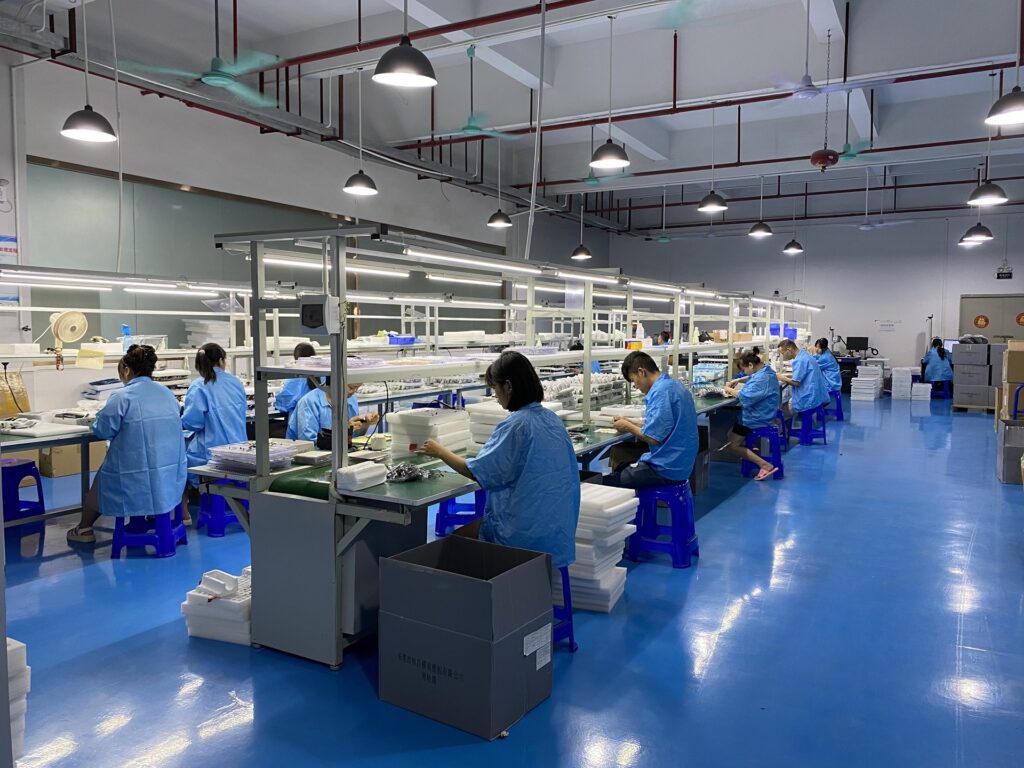
Google’s product cycle is 12-18 months. A small brand in Shenzhen can go from concept to prototype in 4 weeks, iterate twice, and ship in 12 weeks. Speed is your superpower. At HuaHai, we have built our production process around this philosophy — rapid prototyping, flexible batch sizes, and fast iteration cycles.

5. Sell a story, not a spec sheet
Big tech sells on specs: 48 megapixels, 16GB RAM, 5nm chipset. Small brands sell on purpose: “This camera lets you talk to your pet while you are at work.” “These glasses translate conversations in real time so you can travel anywhere.” People buy stories, not specifications.
“The advantage of incumbents is not their intelligence. It is their inertia. And inertia is not a moat.”
The Market Is Already Proving This
Look at the most interesting AI hardware products of the past two years. The Rabbit R1, the Humane AI Pin, the Limitless pendant, the RayNeo V4. None of them were built by the cloud giants. They were built by small teams with a clear vision and access to the same supply chain that big companies use.
Some of these products will fail. That is fine. The point is that the barrier to entry has never been lower. A team of 10 people with $500,000 in funding can now create a hardware product that would have required $50 million a decade ago.
The Only Real Challenge
The hardest part of building an AI hardware brand is not the AI. It is not the hardware. It is the integration. Getting the AI model to run reliably on the chipset, optimizing power consumption so the battery lasts, designing a thermal solution that keeps the device cool, and passing regulatory certification — these are the real challenges. And they are solved by experience, not by money.
This is where a manufacturing partner with 10+ years in smart device production becomes invaluable. They already know the pitfalls. The certification requirements. The component lead times. The failure modes. HuaHai has guided dozens of brands through this process — our team handles everything from PCB layout optimization to CE and FCC certification, so you do not have to learn it the hard way.
None of this means it is easy. But it does mean the path is clearer than most people think. The only question left is whether you will take the first step.
Frequently Asked Questions
Can small brands compete with big tech in AI hardware?
Yes, because big tech is structurally disadvantaged in hardware. Their margins are lower, their cycles are slower, and their focus is on mass-market platforms rather than specific verticals.
What is the biggest advantage of small AI hardware brands?
Speed. A small team can go from concept to production in 8-12 weeks. Big tech companies take 12-18 months for the same process.
Do small brands need their own AI models?
No. Open-source models like Llama 3, Qwen, and Whisper are free, capable, and optimized for edge deployment. The model is rarely the differentiator — the application and user experience are.
What is the biggest risk for small AI hardware brands?
Poor execution on hardware reliability. Software bugs can be patched. Hardware defects require recalls. Quality control and certification are non-negotiable.
Build Your AI Hardware with HuaHai
You have the vision. We have the manufacturing experience. HuaHai Smart Glasses has been building AI-powered wearable devices since 2023. From design to certification to mass production, we help brands turn AI concepts into shippable products. Contact us to discuss your project.