 跳至内容
跳至内容 
AI glasses have emerged as the most exciting wearable category of 2026, with global shipments projected to surge from 6 million to 20 million units this year. While most discussions focus on AI models and optical displays, the unsung hero enabling every feature — from real-time translation to AR overlay rendering — is the storage chip. As an AI smart glasses manufacturer, HuaHai understands that storage chip selection directly determines product performance. As an AI smart glasses manufacturer, HuaHai understands that storage chip selection directly determines product performance. This article explores the critical relationship between storage technology and AI glasses performance.
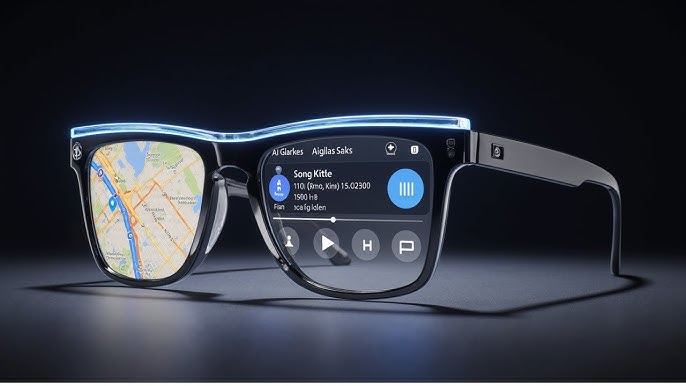
The Hidden Brain Behind AI Glasses
When you put on a pair of AI glasses, dozens of processes happen simultaneously, all within milliseconds:
- 🎤 The microphone captures your voice and sends it to an on-device AI model for natural language processing
- 📷 The camera feeds real-time video for object and scene recognition
- 🕶️ AR graphics are rendered and layered onto your field of view
- 🌐 Wireless data streams in and out for cloud assistance when needed
Every single one of these operations depends on high-speed memory and storage chips working seamlessly together.
Why AI Glasses Need Dedicated Storage Chips
Unlike smartphones, AI glasses have almost zero tolerance for latency, heat, or bulk. A phone can house multiple storage chips across its large motherboard. An AI glass must pack the same computing power into a frame weighing under 40 grams. Every AI glass requires two types of memory:
- DRAM — for real-time computation caching and AI inference
- NAND Flash / eMMC — for persistent data storage and AI model storage
Together, they enable on-device AI inference — processing data locally instead of sending it to the cloud, which reduces latency and protects user privacy.
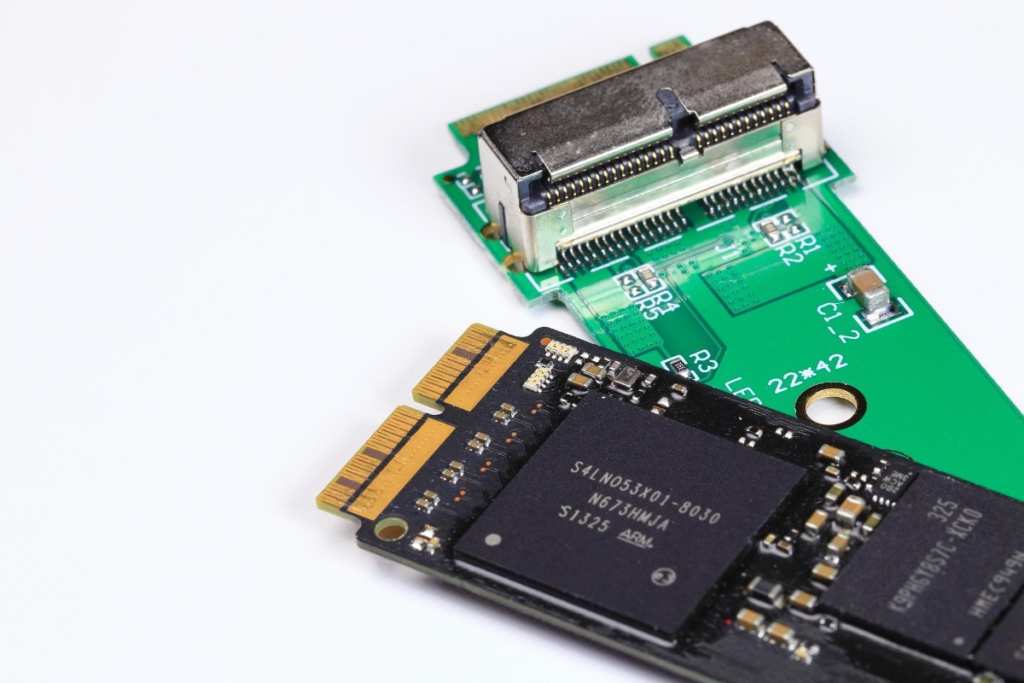
DRAM: The Real-Time Processing Backbone
DRAM (Dynamic Random Access Memory) is the most critical storage component in AI glasses. It temporarily holds the AI model data, sensor inputs, and rendering buffers that the processor needs to access instantly. The industry has standardized on LPDDR (Low Power Double Data Rate) memory for AI wearables. Current-generation AI glasses predominantly use LPDDR4X and LPDDR5X, with the latter offering a superior balance of bandwidth and power efficiency.
| Memory Type | Bandwidth | Power Efficiency | Typical Capacity | Used In |
|---|---|---|---|---|
| LPDDR4X | 34 GB/s | Good | 2-4 GB | Mid-range AI glasses |
| LPDDR5X | 68 GB/s | Excellent | 4-8 GB | Premium AI glasses |
| LPDDR5 (standard) | 51 GB/s | Very Good | 4-6 GB | Flagship wearables |
ePOP: The Space-Saving Revolution
The biggest physical challenge in AI glasses is space. Every square millimeter inside the frame must be optimized. This is where ePOP (embedded Package on Package) technology has become a game-changer. An ePOP chip integrates DRAM and NAND Flash storage into a single package that sits directly on top of the SoC (System on Chip). The benefits are significant:
- ✅ Eliminates separate memory and storage footprints on the PCB
- ✅ Reduces PCB area consumption by up to 40%
- ✅ Shortens signal paths for faster data transfer
- ✅ Simplifies motherboard design and layout
The latest ePOP4x solutions measure just 0.6mm in thickness — 25% thinner than the previous 0.8mm generation. For context, a reduction of 0.2mm in chip thickness can mean the difference between fitting a larger battery or adding an extra sensor. Leading ePOP solutions currently offer configurations of 4GB LPDDR4X + 64GB eMMC, providing ample capacity for AI model storage, photo/video capture, and system operations.
Four Critical Requirements for AI Glasses Memory
| Requirement | Why It Matters | Solution |
|---|---|---|
| Ultra-Low Power | Battery capacity is limited; heat dissipation is poor inside the frame | LPDDR5X’s adaptive voltage scaling reduces power by 20% vs LPDDR4X |
| High Bandwidth | AI inference and AR rendering demand fast data throughput | LPDDR5X delivers 68 GB/s — enough for real-time 4K video + AI processing |
| Compact Footprint | Every millimeter inside the frame matters for design freedom | ePOP packaging reduces PCB footprint by 40% vs discrete components |
| Thermal Stability | Prolonged skin contact requires safe surface temperatures | Low-power LPDDR designs generate minimal heat even under sustained load |
Storage Configurations Compared
| Configuration | RAM | Storage | User Experience |
|---|---|---|---|
| Entry-level | 2 GB | 16 GB | Basic voice commands, limited AI features, frequent data clearing |
| Mid-range (Standard) | 2-4 GB | 32 GB | Smooth voice interaction, basic photo capture, occasional AI processing |
| Premium (Current flagship) | 4 GB | 32-64 GB | Full AI features, 4K video recording, real-time translation, AR overlay |
| Next-gen (Emerging) | 8 GB | 128 GB+ | Local LLM execution, continuous AI processing, heavy content creation |
Real-World Products and Their Storage Choices
RayNeo V4 — Uses ePOP4 solution with 4GB LPDDR4X and 64GB eMMC integrated into a single chip. This configuration supports its AI photography, real-time translation, and voice interaction features while keeping the frame weight at approximately 38 grams. For AI glasses manufacturers exploring similar solutions, HuaHai Smart Glasses offers OEM/ODM services with customizable storage configurations. The integrated ePOP approach frees up PCB space for larger battery capacity and optimized antenna design.
Xiaomi AI Glasses — Adopts a 4GB RAM + 32GB ROM configuration using Longsys ePOP4x storage chips. The 4GB RAM ensures smooth operation of its heterogeneous multi-chip architecture (Qualcomm AR1 + BES2700H co-processor). Xiaomi’s choice reflects a deliberate strategy: adequate memory prevents frequent process recycling, which actually reduces overall power consumption compared to under-configured systems that constantly reload AI models. This mirrors HuaHai’s approach in its camera smart glasses, where memory is optimized for real-time AI processing.
Future Trends in AI Glasses Storage
The trajectory is clear: AI glasses will require more memory, not less. As on-device AI models grow more capable, storage demands will increase. Key trends to watch:
- LPDDR6 adoption — expected bandwidth exceeding 100 GB/s for next-gen AI processing
- Larger ePOP capacities — moving toward 8GB RAM + 128GB+ storage configurations
- 3D heterogeneous integration — memory, storage, and AI accelerators combined in advanced packaging
- Ultra-thin designs — sub-0.5mm chip thickness enabling even slimmer frame profiles
As the market matures, storage chips will transition from being a supporting component to a defining differentiator of AI glasses performance.
FAQ
Why can’t AI glasses just rely on cloud processing?
Cloud processing introduces latency (200-500ms), requires constant connectivity, and raises privacy concerns. On-device AI via dedicated storage chips enables sub-10ms response times.
What is the difference between DRAM and storage in AI glasses?
DRAM temporarily holds data for active processing (like a workspace). Storage (eMMC/NAND) permanently saves data, photos, and AI models. Both are essential and increasingly integrated into single ePOP packages.
How much RAM do AI glasses need in 2026?
4GB is the current sweet spot for smooth AI features. 2GB can run basic functions but struggles with video recording and real-time AI processing. Next-generation devices are moving toward 8GB.
Does more memory drain the battery faster in AI glasses?
Not necessarily. Adequate memory can actually save power by reducing the need to constantly reload AI models and restart processes. The efficiency of LPDDR5X makes 4GB configurations power-neutral compared to 2GB.
Storage Solutions for AI Glasses Manufacturers
Understanding storage technology is critical for AI glasses product development. Whether you are designing the next generation of smart eyewear or sourcing components, the right memory and storage configuration directly impacts your product’s performance, weight, and user experience. Contact us for technical consultation on storage solutions for AI wearable devices.