
Short answer
Most smart glasses last a few hours of active use per charge, and longer for light use such as music or standby. Runtime depends on the feature: video recording and AI drain the battery fastest, while audio and idle time drain it slowest. Makers list runtimes for typical use, so real results are usually lower with heavy camera use.
Key Takeaways
- Battery life varies by model and by feature, so one number never fits all uses.
- Meta lists up to 4 hours for the first Ray-Ban Meta glasses and up to 8 hours for the second generation, for moderate use.
- Camera recording and AI use drain faster than music or standby.
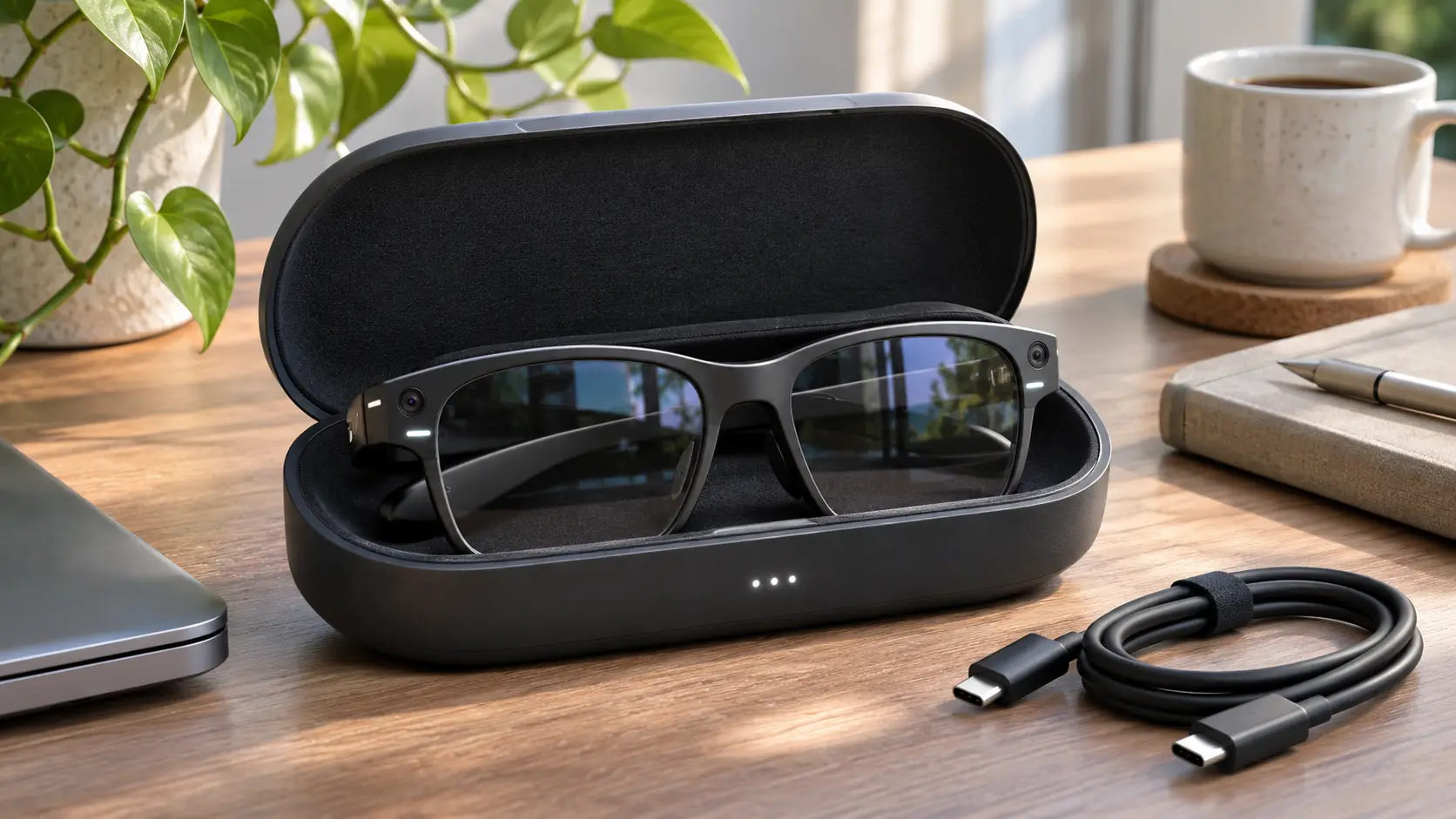
- A charging case adds extra charges, and some models can be used while charging.
How long do smart glasses last on a charge?
Smart glasses last about 4 to 9 hours of typical use on the models Meta lists, with longer standby and shorter heavy recording. The range is wide because the battery is tiny, and each feature uses it differently.
These are the figures Meta’s AI glasses help page lists for its own models:
| Model (as listed by Meta) | Glasses battery | Charging case |
|---|---|---|
| Ray-Ban Meta (Gen 1) | Up to 4 hours, moderate use | Up to 32 hours of charging |
| Ray-Ban Meta (Gen 2) | Up to 8 hours, moderate use | Up to 48 hours of charging |
| Oakley Meta HSTN | Up to 8 hours typical use; up to 5 hours continuous audio | Up to 48 hours; 80% in 45 minutes in the case |
These are manufacturer figures for one brand. Meta states its battery claims are approximate, so treat them as a guide, not a promise.
Which features use the most battery?
Video recording and AI features use the most battery, while music, calls and standby use the least. A pair that lasts all day on standby can run flat in an hour or two of continuous video.
- Video recording: the heaviest use, because the camera and processor run continuously.
- AI assistant and translation: frequent voice use and wireless data add steady drain.
- Photos: short bursts, so lighter than video.
- Music and calls: moderate use. Open-ear speakers draw less than the camera.
- Standby: the lightest drain, which is why standby times are the longest on any spec sheet.
Meta’s own tips for saving battery agree with this list: lower the video resolution, record shorter clips, and turn off adaptive volume and always-on voice activation.
How long do smart glasses take to charge?
Charging takes about an hour on HuaHai’s V03, which lists a 60-minute full charge, and case charging can be faster on some models. Charging speed depends on the battery size and the charger.
- Case charging: Meta lists 80% in 45 minutes in the case for Oakley Meta HSTN, and about 3.5 hours for the case itself.
- Direct charging: many models use a magnetic cable or a Type-C port.
- Cold weather: Meta says charging pauses below 0 °C (32 °F), so charge indoors in winter.
How do HuaHai models list battery life?
HuaHai lists battery life per feature on its product pages, and the figures differ by model. All numbers are as listed on the product pages, not independently tested.
| Model | Listed battery details | Charging |
|---|---|---|
| V03 | 5 hours of music, 23 hours of standby | 60 minutes to full, 2-pin magnetic |
| V06 | About 5 hours of use, 260 mAh battery | Magnetic charging |
| HY16 | Up to 1 hour continuous video, up to 24 hours of music, up to 18 hours of calls | Type-C, usable while charging |
HuaHai also lists a charging case with a 3,600 mAh battery and reverse charging on its M02 Ultra page. See the charging case smart glasses range for case-based models.
Why is real battery life shorter than the spec sheet?
Real battery life is usually shorter because spec sheets measure typical or audio-only use. Heavy camera use, cold weather and a weak signal all shorten runtime.
- Test conditions: makers often measure at moderate volume and light use.
- Heavy features: recording and AI use cut runtime well below the headline figure.
- Temperature: cold weather reduces battery performance and can pause charging.
- Battery age: capacity falls after many charge cycles.
For the engineering side, read battery life: key factors buyers should know, and see how the chip choice affects power in what chip powers smart glasses.
What should brands and distributors check?
Brands should ask for battery life per feature, charging time and case capacity, and test them on a sample before ordering.
- Per-feature runtime: ask for music, calls, recording and standby figures separately.
- Test method: ask how the supplier measured the numbers and at what volume or resolution.
- Charging: confirm charge time, port type and whether the glasses work while charging.
- Battery safety documents: HuaHai’s pages list UN38.3 and MSDS for selected models, so ask for the documents for the exact model.
- Sample test: run your own use case on a sample. Our supplier checklist covers the rest.
Returns often start with battery expectations, so state the runtime per feature in your listing. The downsides of smart glasses article explains which limits buyers notice first.
How does HuaHai approach this?
HuaHai lists battery runtime and charging details on each product page and offers paid samples so buyers can test before ordering. Sample cost is credited against bulk orders, as listed on its product pages.
- In-stock models: V03, V06 and HY16 list a minimum order of 1 pair, as listed on the product pages.
- Samples: branded samples take about 7 to 10 days, as listed.
- Documents: HuaHai’s site lists CE, RoHS, FCC, UN38.3 and MSDS for selected models. Ask for the documents for the exact model.
Sourcing smart glasses for your brand?
Ask HuaHai for battery and charging details per feature for the model you want. Request a quote
Frequently Asked Questions
How long does smart glasses battery life last?
Smart glasses battery life lasts roughly 4 to 9 hours of typical use on the models Meta lists, with shorter runtime for video and longer for music or standby. Check the per-feature figures for the model you choose.
How long do smart glasses take to charge?
Smart glasses take about an hour to charge on models that list a 60-minute full charge, such as HuaHai’s V03. Case charging can be faster, and charging time depends on the battery and charger.
Can you use smart glasses while they charge?
Some smart glasses can be used while charging. HuaHai lists Type-C charging that is usable while charging for its HY16, but check each model’s page.
Does recording video drain smart glasses battery fast?
Yes, recording video drains smart glasses battery fastest of all features. HuaHai lists up to 1 hour of continuous video on its HY16, much shorter than its music time.
How can I make smart glasses battery last longer?
You can make smart glasses battery last longer by lowering video resolution, recording shorter clips and turning off always-on voice activation. Meta also notes that charging pauses in freezing temperatures.
Bottom line
Smart glasses last a few hours of active use and much longer on music or standby, and video and AI drain the battery fastest. Ask for per-feature runtime and test a sample, because spec-sheet figures are usually best-case.