Short answer
No single Chinese brand is best for everyone. Rokid, Xiaomi, Huawei, Alibaba, Baidu and iFlytek lean toward AI assistants, cameras and translation, while XREAL, RayNeo, VITURE and INMO lean toward display (AR) glasses. Decide which type you need first, then check where each brand actually sells, because several launches were China-first.
Key Takeaways
- IDC data reported by TechNode shows global smart eyewear shipments of 3.547 million units in Q2 2026, up 35.3%, while China fell 8% to 611,000 units.
- Display-less audio glasses made up 70.3% of global shipments in Q2 2026, so most buyers still choose glasses without a screen.
- Reported prices range from $249 for Rokid’s Max 2 to $1,299 for RayNeo’s X3 Pro AI+AR glasses, with Chinese-market AI glasses at ¥1,899 to ¥4,299.
- Xiaomi, Huawei, Alibaba, Baidu and iFlytek are covered in the sources we checked as China launches, so confirm warranty and retail support in your own country.
- These ten are finished consumer products. A brand that wants its own name on the glasses sources through OEM/ODM manufacturing instead.
How were these 10 brands chosen?
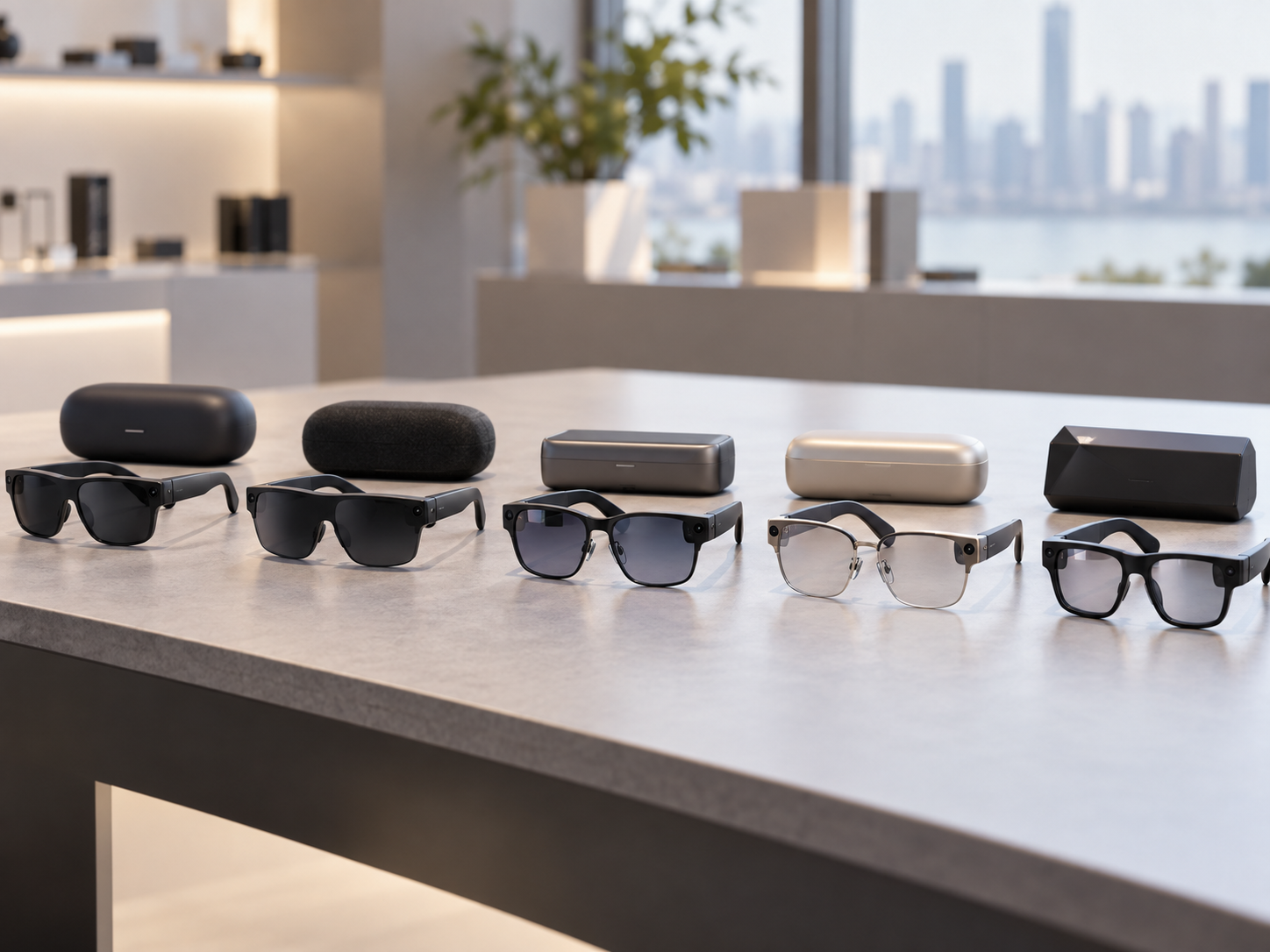
These brands each have a product on sale in 2025 or 2026 with a price published by the brand or reported by a named outlet. They cover both AI glasses, which focus on an assistant, a camera and audio, and AR glasses, which put a screen in your view. The numbering groups brands by type and is not a score.
Three rules kept the list honest:
- Named sources: every price and spec below names its source and date.
- No paid placement: nobody paid to be listed.
- China-first is flagged: if a source does not say where a product sells outside China, we say so.
Prices change often, so treat each figure as a snapshot.
What does the Chinese smart glasses market look like in 2026?
Global demand is growing, but China’s own market fell in Q2 2026. IDC data reported by TechNode puts global smart eyewear shipments at 3.547 million units in the second quarter of 2026, up 35.3% year over year (TechNode, September 17, 2026).
- Global split: audio and camera glasses reached 2.494 million units, AR/ER glasses 505,000 units, and VR/MR headsets fell 23.3% to 548,000 units.
- Largest category: display-less audio glasses were 70.3% of global shipments.
- China: shipments fell 8% to 611,000 units, the market’s first decline, and audio and camera glasses dropped 35.4% to 332,000 units.
- China AR/ER glasses: they grew 123%, which the article partly attributes to lightweight AI glasses.
An earlier IDC figure shows how fast the category moved: global smart glasses shipments reached 4.065 million units in the first half of 2025, up 64.2% (36Kr, January 23, 2026). The same article says that, apart from Meta, the other four of the global top five are Chinese: Xiaomi, Thunderbird, XREAL and VITURE. It gives no period or data source for that ranking, so use it as context only.
Our reading is that the camera-and-audio segment weakened in China while display glasses grew. That makes a brand’s type matter more than its name in 2026.
Which AI-first Chinese glasses are worth comparing?
Six brands lead with an assistant, a camera and translation. Baidu’s glasses have no display, and two others (Alibaba’s S1 and iFlytek’s) add one.
1. Rokid: display and non-display models under one brand
Rokid sells both AI glasses without a display and AR display glasses, so you can pick the type you need within one brand. Its official store lists the Rokid Glasses with a display, the Ai Glasses Style without one, the Max 2 and the AR Spatial.
- Type: AI glasses and AR glasses.
- Best for: buyers who want to compare a camera-and-assistant model with a screen model from one maker.
- Strength: the store describes the non-display Ai Glasses Style as having a camera, live captions and an assistant powered by GPT and Gemini.
- Limit: the store page lists no translation details for any model, so check the product page.
- Price: Ai Glasses Style $329 (list $399), Max 2 from $249, AR Spatial $399 (Rokid official store, checked November 2026, sale prices shown).
2. Xiaomi: a camera-and-assistant model tied to its smart-home range
Xiaomi’s AI glasses combine a 12-megapixel camera and a voice assistant with its smart-home ecosystem. Yicai reported the June 2025 launch with prices from CNY1,999 to CNY2,999 ($280 to $420) (Yicai, June 27, 2025).
- Type: AI glasses with a camera.
- Best for: people who already use Xiaomi smart-home devices.
- Strength: it links to Xiaomi Smart Home devices, uses the Super XiaoAi assistant and supports QR code payment.
- Limit: video clips are up to 10 minutes, and translation runs through third-party apps.
- Availability: the article gives no sales dates or regions.
3. Huawei: HarmonyOS glasses with a titanium frame
Huawei’s first AI glasses launched on April 20, 2026 and start at 2,499 yuan ($345) (TechNode, April 20, 2026). TechNode lists a 12MP camera, simultaneous translation in 42 languages and the Xiaoyi assistant.
- Type: AI glasses with a camera.
- Best for: people already inside the Huawei ecosystem.
- Strength: about 30 to 31 grams, up to eight hours of use and a titanium alloy frame.
- Limit: the article does not cover availability outside China.
4. Alibaba Quark: two models, from budget to micro-OLED
Alibaba’s Quark AI glasses come in a flagship S1 and a cheaper G1, both launched in China on November 27, 2025. Engadget reports the S1 at ¥3,799 ($537) and the G1 from ¥1,899 ($268) (Engadget, November 27, 2025).
- Type: AI glasses, with a display on the S1.
- Best for: shoppers in China who want a camera and a display in one model.
- Strength: the S1 uses micro-OLED and captures images up to 3K and AI-enhanced 4K video.
- Limit: sold on Chinese e-commerce platforms, and Engadget says it is unclear whether the glasses will launch outside China.
5. Baidu Xiaodu: AI glasses without a display
Baidu’s Xiaodu AI Glasses Pro have no display, so they are not classed as AR glasses. Yicai reports a price of CNY2,299 ($322), with sales through JD.com and Tmall (Yicai, November 11, 2025).
- Type: AI glasses with a camera, no display.
- Best for: buyers who want photo, translation and object recognition without a screen.
- Strength: the article lists photo and video capture, AI translation, object recognition, reminders and recording.
- Limit: Yicai notes the price is above the USD 299 Ray-Ban Meta entry model.
6. iFlytek: translation-first glasses with a waveguide display
iFlytek’s AI glasses focus on translation and meeting support, with a resin waveguide display. Biometric Update reports a price of 4,299 yuan (about $635), a weight of about 40 grams and support for 122 languages, accents and dialects (Biometric Update, June 2, 2026).
- Type: AI glasses with a display.
- Best for: face-to-face translation, calls and meetings.
- Strength: an AI agent called GlassClaw transcribes meetings, and the glasses translate text on menus, road signs and slides.
- Limit: the highest price among the six AI-first models here, and the article gives no retail launch date.
Which Chinese AR display glasses are worth comparing?
Four brands put a screen in your view for media, gaming, productivity or translation. Prices below come from the brands’ official stores unless noted.
7. XREAL: display-first AR glasses
XREAL presents its range as AR glasses with optical see-through displays, not as AI assistants. Its homepage lists the XREAL One Pro, 1 Pro+, 1S, ROG XREAL R1 and the AURA, which runs Android XR and lists a 70° optical see-through field of view (XREAL).
- Type: AR glasses.
- Best for: buyers who want a large virtual screen and an established AR range.
- Strength: a wide lineup, and Android Authority calls the XREAL One the closest rival to VITURE’s $499 Luma Pro.
- Limit: the homepage shows no prices, so check the XREAL shop.
8. RayNeo: AR and AI glasses at many price points
RayNeo, which its store names as TCL’s RayNeo brand, sells both AR display glasses and AI glasses across a wide price range. Its US store lists the Air 3s at $269, the GT at $329, the GT Max at $429, the iO AI glasses from $499 and the X3 Pro AI+AR glasses at $1,299 (RayNeo store, checked November 2026).
- Type: AR glasses, AI glasses and AI+AR glasses.
- Best for: buyers who want to compare several tiers inside one brand.
- Strength: the Air 4 Pro (from $299) is described as the first HDR10 display in AR glasses.
- Limit: the store does not state the display technology for its models.
9. VITURE: micro-OLED display glasses for gaming and movies
VITURE makes XR display glasses that act as a large virtual screen for a phone, console or laptop. Its official site lists the Luma at $399, the Luma Pro at $499, the Luma Ultra at $599 and The Beast at $549 (VITURE).
- Type: XR (AR) display glasses.
- Best for: gaming, movies and portable work.
- Strength: Android Authority’s July 2025 review describes Sony micro-OLED panels, up to 1,000 nits, a 52-degree field of view and up to 120Hz on the Luma Pro (Android Authority, July 23, 2025).
- Limit: the reviewer found the built-in audio weak and noted the Luma Pro has no hardware-based tracking.
10. INMO: translation glasses with a microLED display
INMO’s glasses are built around translation and subtitles. Its GO3 page lists a binocular green Micro LED display with a 30° field of view, 640 × 480 resolution and 1,500 nits, plus 127 target languages online and nine offline (INMO).
- Type: AR-style glasses with a display.
- Best for: two-way conversation translation and real-time subtitles.
- Strength: about 58 grams, with photo translation and a voice assistant listed.
- Limit: the page lists translation mode of up to three hours of continuous use and no base price. For reference, the earlier GO 2 launched at ¥3,299 (about $450) (MicroLED-Info, December 2024).
How do the 10 brands compare at a glance?
The table shows type, display and the price each source reports. It is not a test result.
| Brand | Type | Display | Reported price | Where sold (as stated) |
|---|---|---|---|---|
| Rokid | AI + AR | Model dependent | $249–$399 (store) | Official global store |
| Xiaomi | AI | Not stated | ¥1,999–¥2,999 ($280–$420) | No regions stated |
| Huawei | AI | Not stated | From ¥2,499 ($345) | China launch |
| Alibaba Quark | AI | S1 micro-OLED | ¥1,899–¥3,799 ($268–$537) | Chinese platforms |
| Baidu Xiaodu | AI | None | ¥2,299 ($322) | JD.com, Tmall |
| iFlytek | AI | Resin waveguide | ¥4,299 (~$635) | Retail date not stated |
| XREAL | AR | Optical see-through | See XREAL shop | US shop linked |
| RayNeo | AR, AI, AI+AR | Not stated | $269–$1,299 (store) | US store |
| VITURE | XR (AR) | Sony micro-OLED | $299–$599 (site) | Official site |
| INMO | AR-style | Micro LED | GO 2: ¥3,299 (~$450) | Official store |
What is the difference between AI glasses and AR glasses?
AI glasses focus on an assistant, a camera and audio, and many have no display, while AR glasses put a screen in your field of view. IDC separates audio and camera glasses, AR/ER glasses and VR/MR headsets in its tracking (TechNode).
- AI glasses: built for hands-free photos, voice help and translation, such as Baidu’s Xiaodu, which has no display.
- AR glasses: built for a virtual screen or overlaid information, such as VITURE and XREAL.
- Hybrids: Alibaba’s S1, iFlytek and RayNeo’s X3 Pro combine a camera or assistant with a display.
Read our guide to AI glasses vs AR glasses for the full comparison.
How do Chinese brands compare with Western brands such as Meta?
Meta holds the largest share in the data we found, while the Chinese brands here cover a wider range of AI and display designs. Yicai notes that Ray-Ban Meta is not available in China, and that global AI smart glasses sales rose 216% to 600,000 units in the three months to March 31, 2025, mainly on Ray-Ban Meta, citing Wellsenn XR (Yicai).
- Market share: 36Kr reports Meta’s share as 75.7% from IDC data, with no period given.
- Price: Yicai gives USD 299 for the Ray-Ban Meta entry model, a useful baseline for the prices above.
- Support: retail and warranty outside China is the practical gap, so check it before you buy.
What should you check before buying Chinese AI glasses?
Check certification, availability and privacy before you check specifications. The list below covers the points that marketing pages rarely spell out.
- Certification: ask for the actual FCC certificate for the US or CE documents for the EU, not just a claim.
- Availability: confirm the model sells and is serviced in your country, because several launches were China-first.
- Prescription lenses: not every model accepts prescription inserts, and fitting differs.
- Privacy: check whether the model has a camera, whether recording shows an indicator, and where voice and image data are processed. Biometric Update notes privacy concerns around wearable cameras in its iFlytek coverage.
- Updates and battery: look at the app’s update history and ask about battery replacement after the warranty.
Our guides on smart glasses certifications and where recording eyewear is restricted go deeper.
Should you buy one of these brands or build your own?
Buy a finished brand if you want one pair for yourself, and use OEM/ODM manufacturing if you want your own brand on the glasses. All ten brands above sell finished products under their own names, so a distributor or startup sources from a manufacturer instead.
HuaHai is a smart glasses manufacturer that offers OEM/ODM, custom development, sampling and production. Its product pages list these ready-stock camera models:
- V03: listed from $35 per pair at 1,000 pieces, EXW.
- V06: listed from $38 per pair at 1,000 pieces, EXW.
- HY16: listed from $53 per pair at 1,000 pieces, EXW.
Those prices come from HuaHai’s July 2026 price list and exclude freight and duty. The product pages list a 1-piece minimum order for ready-stock models, samples that ship within 48 hours and a 12-month warranty. HuaHai’s site lists CE, FCC and RoHS, so ask for the documents for the exact model you plan to sell.
To plan an own-brand project, start with our OEM and ODM buyer guide, the supplier checklist and the guide to smart glasses MOQ.
Sourcing smart glasses for your own brand?
Frequently Asked Questions
Which Chinese AI glasses are the best?
No Chinese AI glasses brand is best for everyone, because the right choice depends on the type you need. Pick an AI-first model from Rokid, Xiaomi, Huawei, Alibaba, Baidu or iFlytek for camera and translation, or a display model from XREAL, RayNeo, VITURE or INMO for a virtual screen.
Can you buy Chinese smart glasses outside China?
You can buy some Chinese smart glasses outside China, and others were launched for China only. Rokid, RayNeo, VITURE and INMO have official stores with US dollar prices, while the sources we checked for Xiaomi, Huawei, Alibaba and iFlytek give no confirmed overseas sales.
What is the difference between AI glasses and AR glasses?
AI glasses focus on an assistant, a camera and audio, and AR glasses put a screen in your view. Some models, such as Alibaba’s S1 and RayNeo’s X3 Pro, combine both.
How much do Chinese AI glasses cost?
Chinese AI glasses cost from about ¥1,899 ($268) to ¥4,299 (about $635) in China, and US store listings run from $249 to $1,299. The reported prices in this article are snapshots from the sources named for each brand, so check the current price before you buy.
Which Chinese smart glasses have a display?
Alibaba’s S1, iFlytek’s glasses, INMO, RayNeo’s AR and AI+AR models, VITURE, XREAL and Rokid’s display models have displays. Baidu’s Xiaodu AI Glasses Pro have none, and the sources we checked do not list a display for Xiaomi’s or Huawei’s glasses.
Is the Chinese smart glasses market still growing?
The global market is growing, but China’s shipments fell in Q2 2026. IDC data reported by TechNode shows global smart eyewear shipments up 35.3% to 3.547 million units, while China fell 8% to 611,000 units.
Are Chinese AI glasses safe to use?
Safety depends on the specific model, not on the country of origin. Check whether the glasses have a camera, whether recording shows an indicator and where your voice and image data go, and follow the recording rules where you live.
Can I get smart glasses made under my own brand?
You can get smart glasses made under your own brand through OEM/ODM manufacturing. HuaHai offers OEM/ODM, custom development, sampling and production, and its ready-stock models list a 1-piece minimum order.
Bottom line
Choose the type first, then the brand. AI-first glasses suit hands-free photos and translation, display glasses suit media and subtitles, and a brand that wants its own name on the product should look at OEM/ODM sourcing instead of reselling these ten.