
Short answer
Smart glasses are powered by a small system-on-chip (SoC) that combines the processor, an image signal processor for the camera, and often a neural processing unit (NPU) for AI. Around it sit memory, storage, wireless chips and a battery manager. Which chip a pair uses sets its battery life, heat, camera quality and how much AI can run on the glasses.
Key Takeaways
- The main chip is an SoC. Other chips handle wireless, memory, storage and power.
- An on-glass NPU lets some AI run without a phone, but only for small models.
- A more capable chip usually costs battery life and adds heat in a frame that weighs under 50 g.
- Brands should ask the supplier for the SoC name, memory size, firmware plan and supply continuity.
What chip powers smart glasses?
Smart glasses run on a system-on-chip, which puts several processing blocks on one small piece of silicon. The SoC is the brain, and it decides what the glasses can do on their own.
A typical SoC for glasses bundles these blocks:
- CPU: runs the operating system and basic features such as touch controls and notifications.
- Image signal processor (ISP): turns raw camera data into photos and video, and supports stabilization.
- NPU: runs AI tasks such as speech and vision models on the glasses instead of in the cloud.
- Wireless and audio blocks: handle Bluetooth, Wi-Fi and microphone and speaker processing, either inside the SoC or on a companion chip.
Not all smart glasses need a powerful SoC. Audio-only glasses can use a much simpler chip, while camera and AI glasses need more processing.
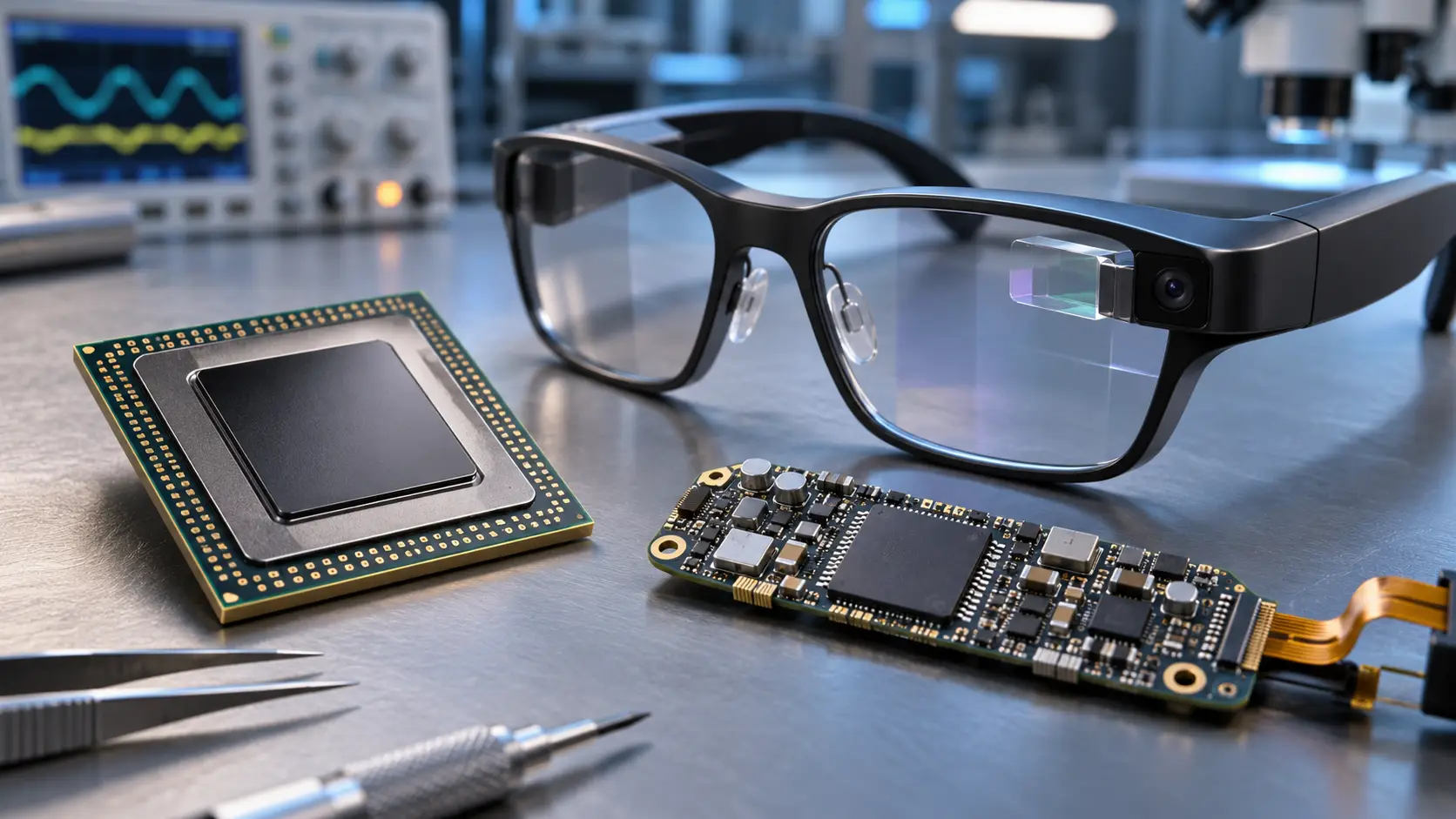
Which chips are used in smart glasses today?
Smart glasses use a mix of purpose-built wearable SoCs, with Qualcomm’s Snapdragon AR line one of the best-known examples. Many camera and audio glasses use lower-cost chips that are not publicly named.
Qualcomm announced the Snapdragon AR1+ Gen 1 in June 2025. Engadget’s report says the company claims it can run AI on the glasses without a smartphone or cloud connection, uses a third-generation Hexagon NPU, and supports small language models of up to 1 billion parameters. Engadget also says it is a modest upgrade over the previous AR1 Gen 1 and describes the chip as smaller and lower power, as a company claim.
Two cautions apply when you read chip news:
- Company claims: size, power and AI figures come from the chip maker, not from independent tests.
- Design wins: a chip announcement does not mean a specific product uses it. Engadget says the chip could appear in future glasses from some brands, which is speculation.
What else is inside the glasses besides the SoC?
Smart glasses also contain memory, storage, wireless chips, sensors and a power management chip. Each affects the product as much as the SoC does.
| Component | What it does | What it affects |
|---|---|---|
| SoC (CPU, ISP, NPU) | Runs software, processes camera images, runs on-glass AI | Speed, camera quality, AI features, heat |
| Memory (RAM) | Holds apps and data while running | Responsiveness, multitasking |
| Storage | Saves photos, video and firmware | How much you can capture before syncing |
| Wireless (Bluetooth, Wi-Fi) | Connects to the phone and transfers files | Pairing, transfer speed, power use |
| Camera sensor | Captures the image | Photo and video quality |
| Power management and battery | Charges and regulates power | Runtime, charging, safety |
The camera sensor is not the SoC. A glasses spec sheet may name a sensor, such as a camera model, without naming the processor.
For more on the storage side, see our deep dive on storage chips in AI glasses.
What are the chip trade-offs in a pair of glasses?
A more powerful chip gives more features but costs battery, heat and weight. In a frame that must stay comfortable on the face, the trade-offs are tight.
- Performance vs battery: more processing draws more power from a small battery, so runtime drops. See battery life factors and our guide to battery life by feature.
- Heat: a chip that warms up next to the temple can make the glasses uncomfortable, so thermal design matters.
- On-glass AI vs phone AI: running a model on the glasses avoids the phone, but only small models fit. Larger tasks are usually handled by the phone or the cloud, as explained in how AI smart glasses work.
- Cost: a high-end SoC raises the bill of materials, which affects your price and margin.
- Camera quality: the ISP and the sensor together decide how good photos and video look, not the CPU alone.
What should brands and distributors check?
Brands should ask the supplier for the exact SoC name, memory and storage sizes, firmware plan and supply continuity before they commit to a model.
- SoC name: ask which chip is used, who makes it and whether it is a standard part.
- Memory and storage: confirm RAM and onboard storage sizes in writing.
- AI features: ask which functions run on the glasses and which need the phone or cloud.
- Firmware: ask who writes and updates the firmware, and whether over-the-air updates are supported.
- Supply continuity: ask how long the chip will stay in production, so a model is not discontinued mid-season.
- Documents: request test and certification documents for the exact model, and see our guide on smart glasses certifications.
Our 12-point supplier checklist covers the rest of the buying process.
How does HuaHai approach this?
HuaHai lists camera, storage and connectivity details on its product pages and does not publish the SoC name for each model. Ask for the chip details for the exact model during quoting.
- V03 AI Smart Glasses with Camera: HuaHai lists an 8MP IMX219 sensor, 2GB onboard storage, Bluetooth 5.3 and 2.4G Wi-Fi.
- HY16 AI Camera Smart Glasses: HuaHai lists a GalaxyCore 12MP camera and Type-C charging.
- Customization: HuaHai’s product pages list SDK and App interface customization from 3,000 pieces and App launch logo from 3,000 pieces, with minimums that differ by option and model.
- Samples: HuaHai’s pages say samples are paid, with the cost credited against bulk orders.
Specs are as listed on the product pages, not independently tested. The camera smart glasses range shows the models.
Sourcing smart glasses for your brand?
Tell HuaHai the features you need and ask for the chip and firmware details for the exact model. Request a quote
Frequently Asked Questions
What chip do smart glasses use?
Smart glasses use a system-on-chip that combines a CPU, an image signal processor and often an NPU. The exact chip varies by product, from simple low-power parts to wearable-specific SoCs such as Qualcomm’s Snapdragon AR line.
Do smart glasses have a processor?
Yes, smart glasses have a processor, usually part of a system-on-chip. Even audio-only glasses have a small chip to manage Bluetooth, audio and controls.
Can smart glasses run AI without a phone?
Some smart glasses can run small AI models without a phone if the chip has an NPU. Qualcomm says its Snapdragon AR1+ Gen 1 supports this, but larger tasks usually still use the phone or the cloud.
Does a better chip mean longer battery life?
A better chip does not automatically mean longer battery life. A more efficient chip can help, but a more powerful one uses more power, so runtime depends on the whole design.
How can a brand find out which chip a supplier uses?
A brand can find out which chip a supplier uses by asking for the SoC name in writing during quoting. Also ask for memory and storage sizes, the firmware plan and how long the chip will stay in supply.
Bottom line
Smart glasses run on a small SoC, supported by memory, storage, wireless and power chips, and the right choice is a balance between features, battery and heat. Ask your supplier to name the chip and its supply plan for the exact model.