
Short answer
Open-ear speakers and bone conduction both leave your ear canal open, but they send sound in different ways. Open-ear speakers are small drivers in the frame that aim sound at your ear. Bone conduction vibrates against the skull. Xiaomi says speakers give richer sound, and buyers who want less leakage often look at bone conduction, so test the exact model.
Key Takeaways
- Open-ear glasses use small speakers in the frame; bone conduction sends vibrations through the skull to the inner ear.
- Xiaomi says its open-sound-field audio glasses give more natural, richer sound than bone conduction, which it says often costs clarity, depth and volume.
- Neither type protects your hearing at high volume: NIDCD says repeated exposure to sounds at or above 85 dBA can cause hearing loss.
- Fit, microphone quality for calls, wind noise and sound leakage matter as much as the driver type.
- HuaHai’s three fully specified models (V03, V06, HY16) list speaker-based audio; ask for a quote if you need a bone-conduction build.
How does bone conduction work in smart glasses?
Bone conduction carries sound as vibration through the bones of the skull instead of through the air. Imperial College London describes how vibrations travel to the temporal bone and on to the basilar membrane in the inner ear, where tiny hair cells pass the signal to the brain (Imperial College London, July 9, 2014).
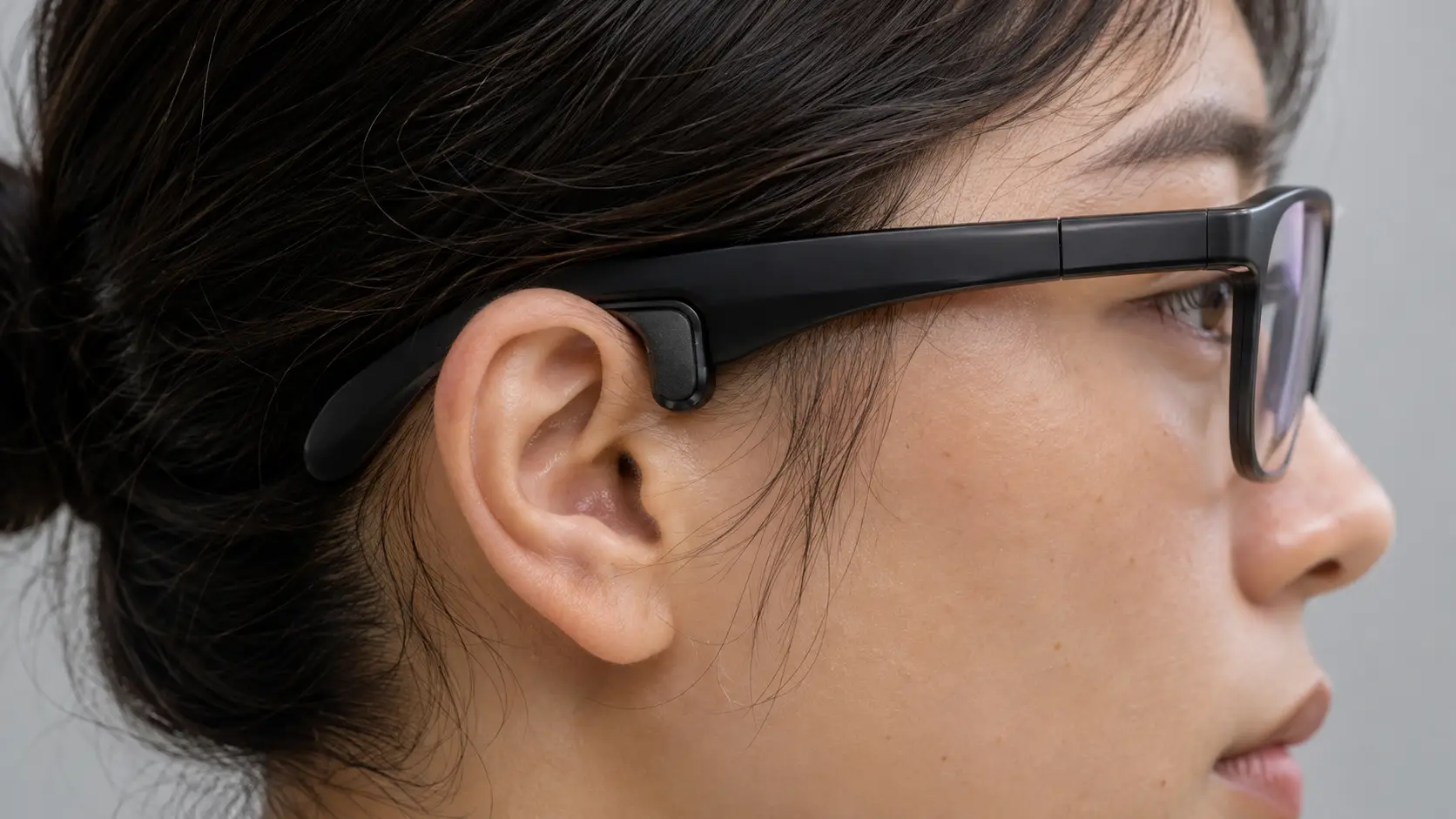
In glasses, a small transducer sits against the head, usually near the temple or just in front of the ear. Three points follow from the physics:
- Contact matters: the transducer has to touch the head with steady pressure, so the temple tips and the wearer’s head shape affect the result.
- The ear canal stays open: you hear traffic and voices through the air at the same time as the audio.
- Low frequencies travel well: Imperial notes that bone conduction transmits lower-frequency sound effectively, which is why you hear your own voice as deeper than a recording of it.
How do open-ear speakers work in smart glasses?
Open-ear speakers are small drivers built into the temple arms that point sound toward your ear without sealing it. Xiaomi describes this as an “open sound field” solution that relies on small drivers embedded in the frame to project sound directly to your ears (Xiaomi support FAQ).
The same page says this gives more natural and richer sound than bone conduction. That is a manufacturer’s own statement, not an independent test, so treat it as one data point.
- Sound path: through the air, like a very small speaker held beside the ear.
- Leakage: because the sound is in open air, people nearby can hear it at higher volumes.
- Wind and noise: speakers sit outside the ear, so wind and loud surroundings can compete with the audio.
- Calls: open-ear glasses usually add one or more microphones in the frame, and call quality depends on how well they cope with noise.
How do the two compare?
Open-ear speakers tend to win on sound quality and everyday comfort, while bone conduction tends to win on privacy at low volume. The table summarizes the trade-offs in general terms; exact results vary by model and by head shape.
| Factor | Open-ear speakers | Bone conduction | What to check |
|---|---|---|---|
| How sound travels | Through the air to the ear | Through the skull to the inner ear | Driver type on the spec sheet |
| Sound character | Xiaomi describes richer, more natural sound | Xiaomi says clarity, depth and volume are often reduced | Listen with music, speech and a call |
| Ear canal | Open | Open | Both let outside sound in |
| Sound leakage | Can be heard by others at higher volume | Generally less audible to others at low volume | Test in a quiet room |
| Fit sensitivity | Depends on speaker position near the ear | Depends on steady contact with the head | Try different head sizes and hairstyles |
| Wind and noise | Exposed to wind | Less dependent on air path | Test outdoors |
Which one is safer for running, cycling and commuting?
Both types leave the ear canal open, so neither blocks outside sound the way sealed earbuds do. The safety difference comes from volume, not from the driver type.
NIDCD says sounds at or below 70 dBA are unlikely to cause hearing loss even after long exposure, while long or repeated exposure to sounds at or above 85 dBA can cause it. It lists music through headphones at maximum volume at 94 to 110 dBA (NIDCD, noise-induced hearing loss).
- Keep volume moderate: an open ear does not make a high volume safe.
- Know the local rules: some places restrict headphone use while driving or cycling. Check the rules where you sell and avoid making safety claims for your product.
- Stay aware: at a volume that masks traffic or voices, the awareness benefit of either type disappears.
For sports use, our comparison of open-ear smart glasses vs AirPods covers fit and sweat in more detail.
Which one suits which use?
Pick the driver type by the main use case, then confirm on the exact model.
- Music and podcasts at home or the office: open-ear speakers, because fuller sound is the main goal and leakage is manageable at low volume.
- Calls and voice assistants: either type works if the microphones handle noise; judge the microphones, not the driver.
- Quiet shared spaces: bone conduction at low volume, because less sound reaches people nearby.
- Windy outdoor use: test both outdoors, since wind affects speakers more than vibrations.
- Prescription wearers: check the frame first; the audio type matters less than whether the lenses fit.

How should you test audio on a sample pair?
Test the sample the way your customers will use it, not at a desk. A short, repeatable test protects you from reviews that blame the audio when the real problem is fit or microphones.
- Play three kinds of audio: a music track with bass, a podcast with speech and a phone call, each at 30%, 60% and 90% volume.
- Check leakage: sit in a quiet room and ask a second person at arm’s length what they hear at each volume.
- Walk outdoors: repeat in light wind and near traffic noise, and note when the audio becomes hard to follow.
- Make a call: ask the other person how your voice sounds in a quiet place and on a street.
- Wear it for an hour: note pressure behind the ear or at the temple, and repeat with at least three different head sizes.
Write down the results for each sample. They become your internal acceptance test when you compare suppliers or approve a production batch.
Which audio problems should you test for?
Audio problems in glasses often come from fit and calls as much as from the driver type. Use the list below as a checklist for your own testing, and confirm each point on the model you plan to sell.
- Thin bass: expected from small drivers with the ear left open; set the right expectations on the product page.
- Sound that disappears in wind or traffic: common outdoors, and a reason to test where the product will be used.
- Pressure behind the ear: more likely when temple arms clamp tightly, and a reason to include temple-tip options.
- Voice that sounds muffled to the caller: usually a microphone and noise-reduction issue, so judge it on a real call.
- App and pairing issues: an audio product that connects badly gets blamed on the sound, so test pairing on both phone systems.
Do bone conduction glasses help people with hearing loss?
Bone conduction bypasses the outer and middle ear, but smart glasses are consumer audio products, not medical devices. Anyone with a hearing problem should ask a hearing professional before relying on any audio product.
Brands should avoid claims that glasses help with hearing loss. Describe what the product does: it plays audio without covering the ear.
What should brands and distributors check?
Ask the supplier for facts about the audio chain, not just the words “bone conduction” or “open-ear” on a listing. Returns and bad reviews can come from fit, call quality and leakage.
- Driver type and count: how many speakers or transducers, and where they sit in the temple arm.
- Microphones: how many, and whether noise reduction is used for calls.
- Maximum volume and limits: whether the product has a volume cap or warnings in the app.
- Fit range: temple tip shape and clamping force, with samples worn by different head sizes.
- Water and sweat rating: a listed rating for the exact model, such as IPX4 on the V06 page.
- Battery by use: listed hours for music and calls separately; see our guide to AI glasses battery life.
- Documents: certificate copies for the exact model; use the supplier checklist to organize the request.
How does HuaHai approach this?
HuaHai’s models with full specifications on its site list speaker-based audio. This is what its product pages say:
- V03: two 1W speakers and dual noise-reduction microphones, with 5 hours of music and 23 hours of standby listed.
- HY16: open-ear speakers with a P13 composite diaphragm, with up to 24 hours of music and up to 18 hours of calls listed.
- V06: open-ear audio, IPX4 splash resistance and a removable inner frame for prescription lenses.
These figures are listed on the product pages, not measured by us. HuaHai’s pages do not describe a bone-conduction model, so if you need one, send your target specification and ask for a quote. The Bluetooth audio glasses page shows the audio category, and the MOQ guide explains minimums for custom work.
Sourcing audio smart glasses for your brand?
Frequently Asked Questions
Can people nearby hear bone conduction smart glasses?
People nearby can hear bone conduction smart glasses at higher volumes, though they are generally less audible to others than open-ear speakers at low volume. Test the exact model in a quiet room before you promise privacy.
Are open-ear speaker glasses better than bone conduction?
Open-ear speaker glasses are usually described as better for music, and Xiaomi says its open-sound-field glasses give richer sound than bone conduction. Bone conduction suits some buyers who want less leakage, so the better choice depends on the use.
Are bone conduction glasses safe to wear while cycling or running?
Bone conduction glasses leave the ear canal open, which lets you hear surroundings, but safety also depends on volume and local rules. NIDCD warns that repeated exposure to sounds at or above 85 dBA can cause hearing loss, so keep volume moderate.
Can I get prescription lenses in smart glasses with speakers or bone conduction?
You can get prescription lenses in some smart glasses with speakers or bone conduction, depending on the frame. HuaHai lists a removable inner frame for prescription lenses on the V06 and swappable lenses on the HY16; see our prescription lens guide.
Is audio quality in smart glasses as good as headphones?
Audio quality in smart glasses is usually a trade-off against headphones, because the drivers are small and the ear stays open. Bass is typically the first thing buyers notice, so judge the glasses by use case, not by headphone standards.
Bottom line
Choose open-ear speakers for fuller sound and everyday comfort, and consider bone conduction when low leakage matters more. Either way, the real differences come from fit, microphones and volume, so test the exact model and ask the supplier for specifications you can verify.