
Short answer
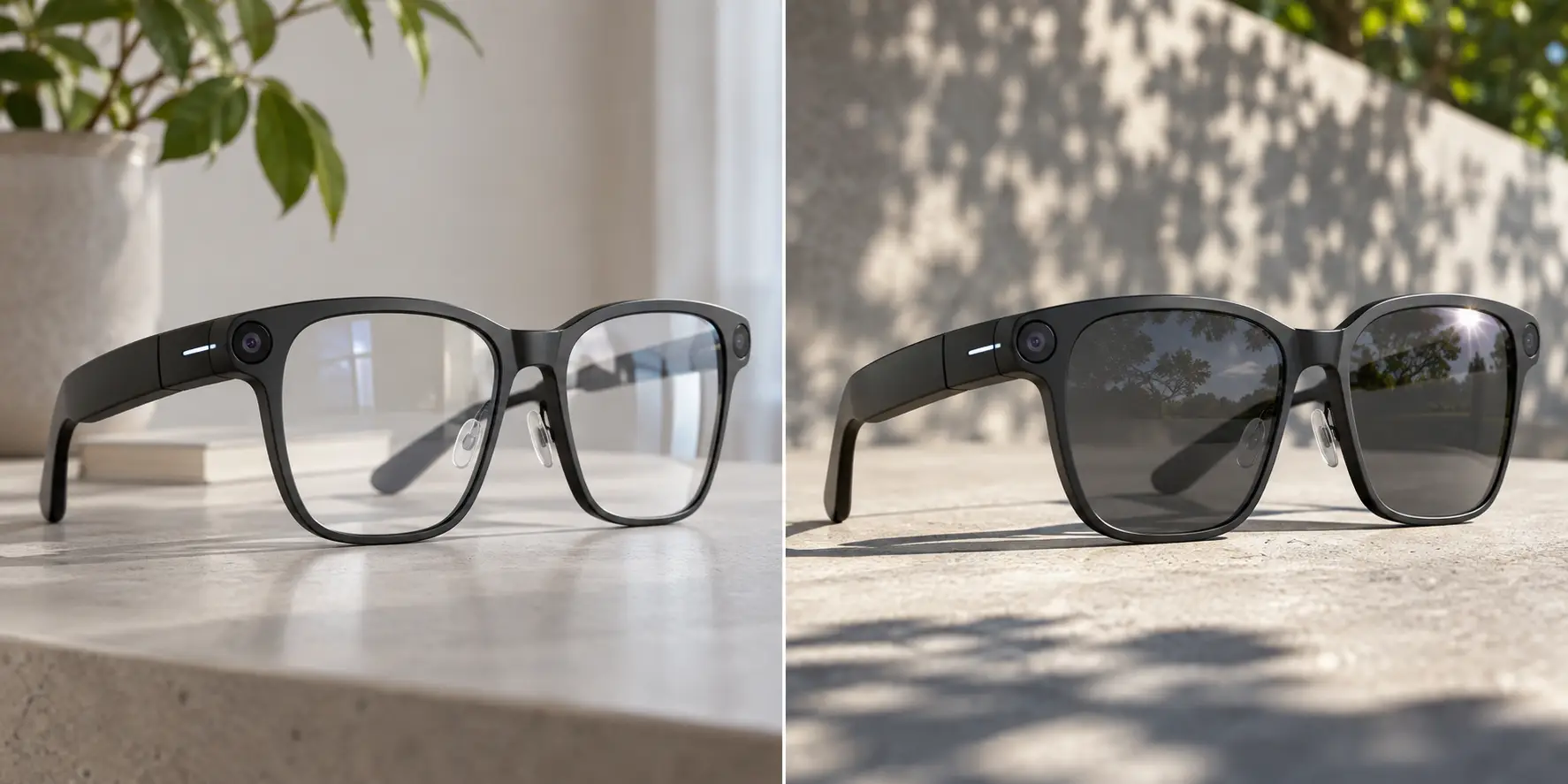
Photochromic smart glasses use lenses that are clear or nearly clear indoors and darken automatically in sunlight. The change is triggered by ultraviolet (UV) light, not by the electronics, so the lenses work the same way as on ordinary photochromic glasses. They suit buyers who move between indoors and outdoors all day, but they do not replace dark sunglasses or driving glasses.
Key Takeaways
- Photochromic lenses darken when UV light reaches them and fade back indoors; the effect is a reversible molecular change, not an electronic one.
- AllAboutVision says some lenses can fully darken in about 30 to 60 seconds, while clearing can take about two to three minutes.
- Traditional photochromic lenses may not darken inside a car, because the windshield blocks some UV.
- On smart glasses, the lens is a separate part from the camera, speakers and battery, so lens options depend on the frame.
- HuaHai lists photochromic, polarized and gradient lens options as customization from 500 pieces per option; it does not list a model that ships with them.
What are photochromic lenses?
Photochromic lenses are eyeglass lenses that are clear or nearly clear indoors and darken automatically in sunlight. AllAboutVision notes that they are also called light-adaptive, light-responsive or variable-tint lenses, and that people often call them “transition lenses” (AllAboutVision, updated October 7, 2026).
“Photochromic smart glasses” simply means smart glasses fitted with this kind of lens. The audio, camera or assistant features work independently of the lens tint.
How do photochromic lenses work?
Photochromic lenses work through photochromism, a reversible molecular change triggered by light. AllAboutVision explains that early lenses used silver halide or silver chloride, while modern lenses use dyes whose molecules darken when UV rays activate them.
- UV is the trigger: the lens reacts to ultraviolet light, not to the brightness you see.
- Clouds do not stop it: AllAboutVision says UV rays penetrate clouds, so the lenses darken on overcast days as well as sunny ones.
- The change reverses: when UV drops, for example indoors, the lens returns toward clear.
- No battery involved: the effect comes from the lens material, so the glasses’ battery does not power it.
Some products use electronically controlled tinting instead. This article covers UV-reactive photochromic lenses only.
How fast do photochromic lenses change?
Speed varies by lens design, manufacturer, temperature and lighting. AllAboutVision says some products can fully darken in around 30 to 60 seconds, while returning to clear can take about two to three minutes under normal conditions.
| Condition | What AllAboutVision says | What it means for buyers |
|---|---|---|
| Darkening | Can be around 30 to 60 seconds for some products | Ask for the supplier’s tested speed |
| Clearing | About two to three minutes under normal conditions | Expect a short delay when walking indoors |
| Cold weather | Lenses darken more intensely but take longer to clear | Test in the climates you sell into |
| Cloudy days | UV passes through clouds, so lenses still darken | Do not promise “clear on cloudy days” |
| Behind a windshield | Traditional lenses may not darken; some newer ones respond to visible light too | Do not market for driving without proof |
Do photochromic lenses work in a car?
Traditional photochromic lenses may not darken inside a vehicle, because the windshield glass blocks some UV rays. AllAboutVision adds that recent advances let some photochromic lenses respond to both UV and visible light, giving some darkening behind a windshield.
For a brand, that means two things:
- Do not claim driving performance: unless the supplier gives test evidence for the exact lens.
- Do not give driving advice: point buyers to local rules and their eye-care professional.
How do photochromic lenses compare with other lens options?
Photochromic lenses trade convenience for darkness. They reduce the need to carry a second pair, but AllAboutVision says they may not be as dark as some sunglass lenses, so some situations still call for sunglasses.
| Lens option | Behavior | Best for | Main limit |
|---|---|---|---|
| Clear lens | Stays clear | Indoor and night use | No sun protection from tint |
| Photochromic | Darkens in UV, clears indoors | People moving in and out all day | May not be as dark as sunglasses; slower in car |
| Polarized | Reduces glare from reflective surfaces | Water, snow, sand, concrete | Fixed darkness unless combined with photochromic |
| Fixed tint (sunglass) | Always dark | Bright outdoor use | Too dark indoors |
AllAboutVision also says polarization can be combined with photochromic lenses, which can help during activities such as cycling or skiing.
Who needs photochromic lenses on smart glasses?
Photochromic lenses suit buyers who switch between indoor and outdoor settings several times a day and want one pair. They add little for people who wear smart glasses only indoors or only in bright sun.
- Commuters and travelers: one pair covers the office, the street and transit.
- Walkers and cyclists: useful for changing light on a route; check the speed and the tint depth first.
- Prescription wearers: a lens that serves as everyday glasses and light sunglasses removes one pair; see our guide to prescription lenses on smart glasses.
- Who can skip them: buyers who want a fixed dark lens for bright outdoor use, or clear lenses for indoor and night use only.

Is UV protection a reason to choose them?
UV protection is a real reason to pay attention to lenses, but check the protection rating, not the tint. The World Health Organization says acute UV effects on the eye include photokeratitis and photoconjunctivitis, and chronic effects include cataract, and it advises wraparound-style sunglasses that provide 99 to 100% UV-A and UV-B protection (WHO, ultraviolet radiation fact sheet).
AllAboutVision says photochromic lenses help protect the eyes from 100% of the sun’s UVA and UVB rays. A tint level alone does not tell you the UV rating, so ask for the lens specification and a test report.
Brands should not make health claims. Describe what the lens does and give the supplier’s documented UV figure.
What changes when the lenses sit on smart glasses?
On smart glasses the lens is a separate part from the electronics, so the lens choice is mostly a frame and fit question. These are the points to confirm on the exact model:
- Lens swap: whether lenses can be replaced, as HuaHai lists for the HY16, or whether the lens is fixed to the frame.
- Prescription path: whether the frame takes a prescription insert, as HuaHai lists for the V06’s removable inner frame.
- Weight: lens material changes weight, which matters on a frame that already carries a battery.
- Camera position: on many designs the camera sits in the frame, not behind the lens; confirm that a tint does not affect it.
- Displays: if the product shows information in front of the eye, ask whether tinted lenses change what the wearer sees.
What should brands and distributors check?
Ask the supplier for lens facts in writing, because “photochromic” on a listing does not say how the lens behaves. Slow or weak tinting can lead to returns and bad reviews for the whole product.
- Technology: UV-reactive dye, how it is applied (in the material or as a coating) and for which lens material.
- Speed: darkening and clearing times, with the test conditions and temperature.
- Tint depth: how dark it gets outdoors, so you can describe it honestly next to fixed sunglass lenses.
- UV rating: a documented figure for the exact lens, not a general claim.
- Durability: scratch resistance and how the tint performs after repeated cycles.
- Minimums and lead time: lens options usually have their own minimum order; see our MOQ guide.
- Documents: certificate copies for the exact model; use the supplier checklist.
How should you describe photochromic lenses on a product page?
Describe the lens in plain terms and promise only what the supplier has documented. Vague claims such as “adapts to any light” invite returns when a buyer tries the glasses in a car or on a cloudy morning.
- Say what triggers it: the lenses react to UV light, so they behave differently indoors, in cars and in shade.
- Give a range, not a promise: state tested darkening and clearing times with the conditions.
- Separate it from sunglasses: say the lenses may not be as dark as dedicated sunglass lenses.
- Avoid health and driving claims: stick to the documented UV rating and point readers to local rules for driving.
How does HuaHai approach this?
HuaHai lists lens options as customization, not as a standard feature of its stock models. This is what its product pages say:
- Lens customization: lens types such as photochromic, polarized and gradient are listed from 500 pieces per option, and each option has its own minimum per model.
- HY16: lenses can be swapped between sunglasses, clear and prescription.
- V06: a removable inner frame holds prescription lenses fitted by an optometrist.
- Stock models: V03, V06 and HY16 list no minimum order for standard ready-stock units, with a 12-month warranty.
These details are listed on the product pages, not measured by us. HuaHai’s pages do not say that any stock model ships with photochromic lenses, so ask for a sample if you need them. See the OEM and ODM buyer guide for the full customization process.
Sourcing smart glasses with custom lenses?
Frequently Asked Questions
What are photochromic smart glasses?
Photochromic smart glasses are smart glasses fitted with lenses that darken in UV light and fade back indoors. The tint comes from the lens material, not from the glasses’ electronics or battery.
Do photochromic lenses work behind a car windshield?
Photochromic lenses may not darken behind a car windshield, because the glass blocks some UV rays. AllAboutVision says some newer lenses also respond to visible light and darken a little behind a windshield.
How long do photochromic lenses take to darken and clear?
Photochromic lenses can fully darken in about 30 to 60 seconds for some products and take about two to three minutes to clear, according to AllAboutVision. Speed depends on the lens design, temperature and lighting.
Are photochromic lenses as dark as sunglasses?
Photochromic lenses may not be as dark as some sunglass lenses, so certain situations still call for sunglasses. Ask the supplier for tint depth data if you plan to describe the lenses as sunglasses.
Can I order photochromic lenses on HuaHai smart glasses?
You can ask HuaHai about photochromic lenses as a customization option, which its product pages list from 500 pieces per option. The pages do not state that any stock model ships with photochromic lenses, so request a quote for your model.
Bottom line
Photochromic lenses add all-day convenience to smart glasses, not a new feature of the electronics. Ask for the speed, tint depth and UV rating of the exact lens in writing, and plan for a custom minimum order if you want them on your own brand.